How Long Does Vinyl Siding Last?
Vinyl siding lasts 20 to 40 years on a house, and steady care can stretch that past 60 years. Sun, hail and poor nailing push panels toward the short end of the range.
By the ACM Pros team, Madison, AlabamaPublished 11 minute read
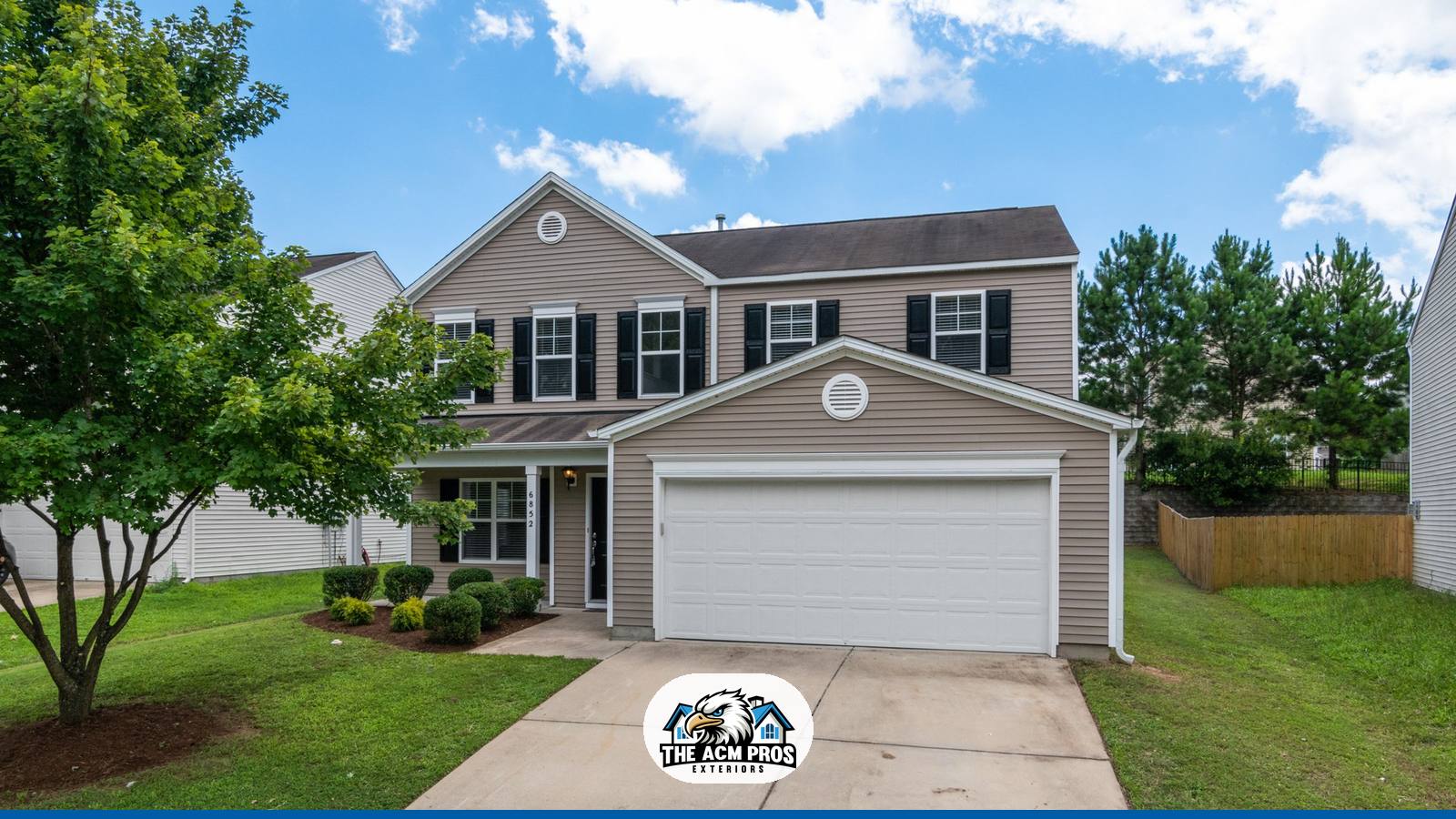
Vinyl siding lasts 20 to 40 years on a house, and steady care can stretch that past 60 years. Sun, hail and poor nailing push panels toward the short end of the range. Yearly washing and loose fastening keep panels near the long end. Cost guides split the middle, with Fixr at 20 to 30 years. The Spruce reports 30 to 40 years for average vinyl siding.
Key Takeaways
- Vinyl siding lasts 20 to 40 years, and well-kept siding can pass 60 years.
- Sun exposure, hail, installation quality and cleaning habits decide where a house lands in that range.
- Fading, cracks, warped panels and moisture behind the wall signal that replacement is near.
- Fiber cement lists at 50 years, while wood and aluminum fall near vinyl.
- One yearly wash with mild soap and water protects the finish.
How Long Does Vinyl Siding Last on a House?
Vinyl siding lasts 20 to 40 years on a house under normal conditions. Mild climates and careful installs can push that past 40 years.
The Spruce reports 30 to 40 years for average siding, with 60 years or more when homeowners clean and inspect it. Fixr lists standard siding at 20 to 30 years. A replacement siding plan begins once panels crack, warp or fade past repair.
The chart below shows how the published ranges stack up before the next section explains the gaps.
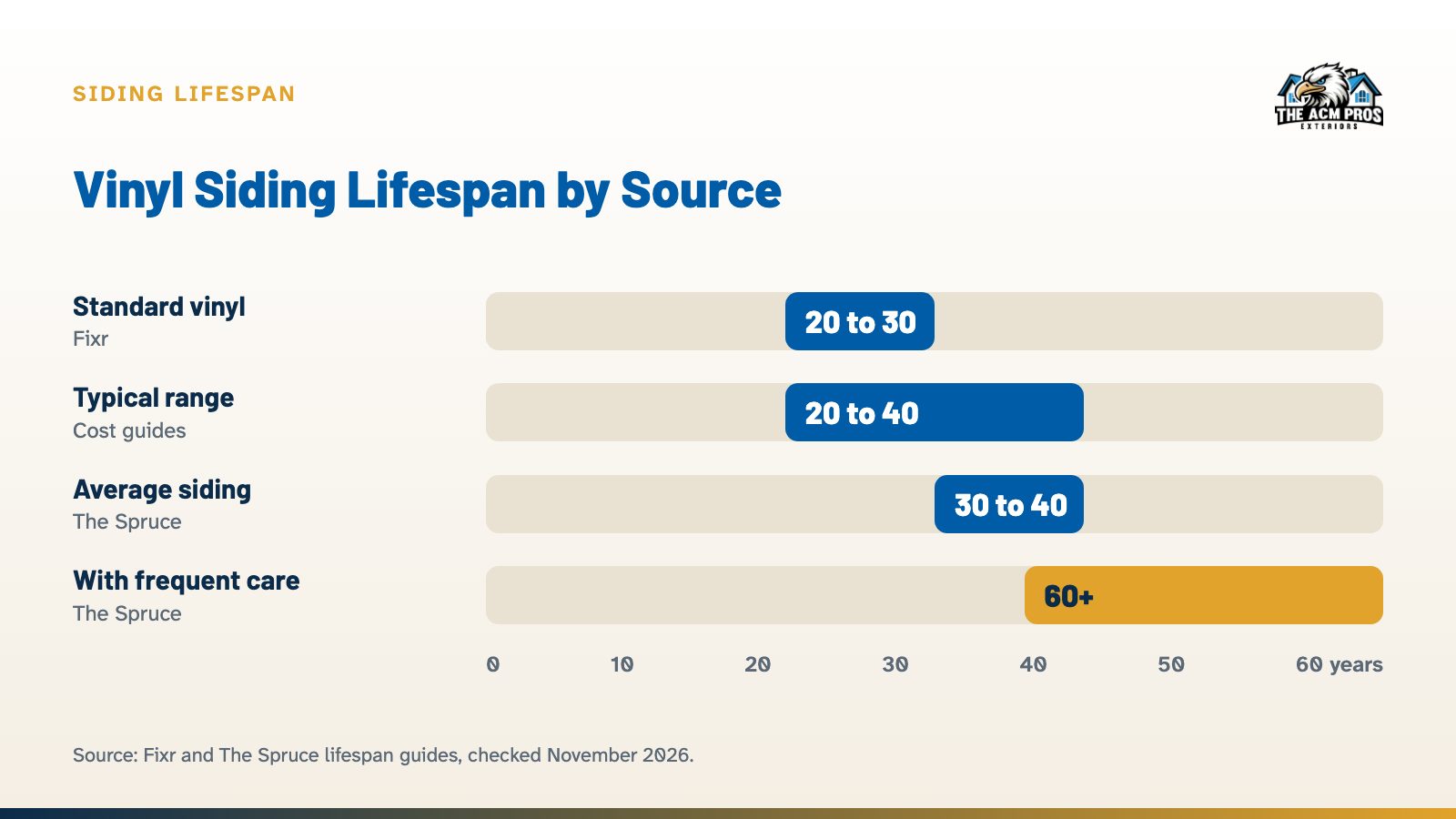
Each bar comes from a named guide, so the ranges overlap without conflicting. Owners who ask how long will vinyl siding last can read the overlap as 20 to 40 years.
What Is the Average Lifespan of Vinyl Siding?
The average lifespan of vinyl siding is 20 to 40 years, and published figures cover different slices.
The table lists each published figure so the differences are easy to read.
Published Vinyl Siding Lifespan Figures
| Source | Lifespan | What it describes |
|---|---|---|
| Fixr | 20 to 30 years | Standard vinyl siding |
| The Spruce | 30 to 40 years | Average with cleaning and repairs |
| The Spruce | 60+ years | Siding with frequent care |
| HUD inspection guide | 50 years | Component life chart |
| InterNACHI chart | 60 years | Component life chart |
| Fannie Mae tables | 25 years | Rental apartment budgeting |
The spread exists because each source answers a different question. Cost guides track what homeowners see in practice. Component charts show what well-made panels can reach, and lender tables budget conservatively.
Vinyl siding life expectancy therefore runs 20 to 40 years for planning. Several forces move a house within that range.
What Factors Decide How Long Vinyl Siding Lasts?
Four factors decide how long vinyl siding lasts: sun exposure, panel grade, installation quality and upkeep. Storm impact adds a fifth for homes in hail country.
The IBHS notes that siding shields the wall from ultraviolet light, temperature swings and wind-borne debris. Each of those exposures wears on the panel over time. The table pairs each factor with what shortens or extends life.
Factors That Change Vinyl Siding Lifespan
| Factor | Shortens life | Extends life |
|---|---|---|
| Sun exposure | Fading and brittleness on sunny walls | Shade from trees and eaves |
| Panel grade | Thin builder grade, 0.040 in | Premium grade, 0.046 in |
| Installation | Nails driven tight against the panel | About 1/32 in nail clearance |
| Impact | Hail and debris on older panels | Flexible, newer panels |
| Upkeep | Mold and dirt left on the surface | One yearly wash and inspection |
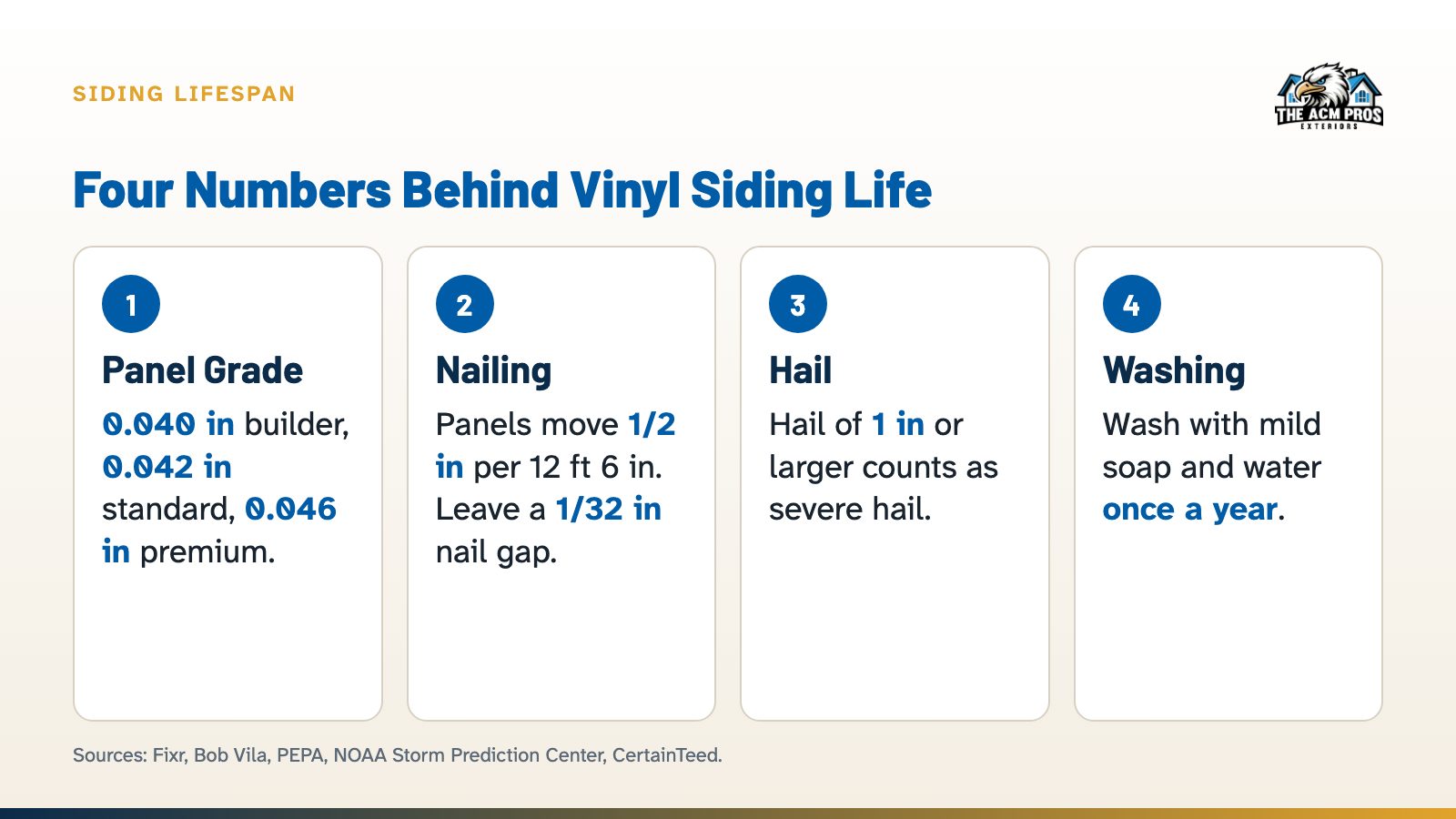
The graphic shows the numbers behind four factors, and the sections below take each in turn, starting with sun.
How Does Sun Exposure Affect Vinyl Siding?
Sun exposure affects vinyl siding by fading color and stiffening the panel over the years. South-facing walls take direct light for more hours of the day.
The Spruce states that sunlight can fade, stiffen and crack siding over time. Shade from mature trees and deep eaves slows that wear. Heat and climate come up again in the hot-climate section.
Does Panel Grade Change How Long Vinyl Siding Lasts?
Panel grade changes the lifespan of vinyl siding because thicker vinyl tends to last longer than budget panels. Builder grade measures 0.040 in, standard grade 0.042 in and premium grade 0.046 in, according to Fixr and Bob Vila.
Thicker panels resist cracking and waviness better. Grade is chosen at the quote stage, so the decision happens on day one.
How Does Installation Quality Affect Vinyl Siding Life?
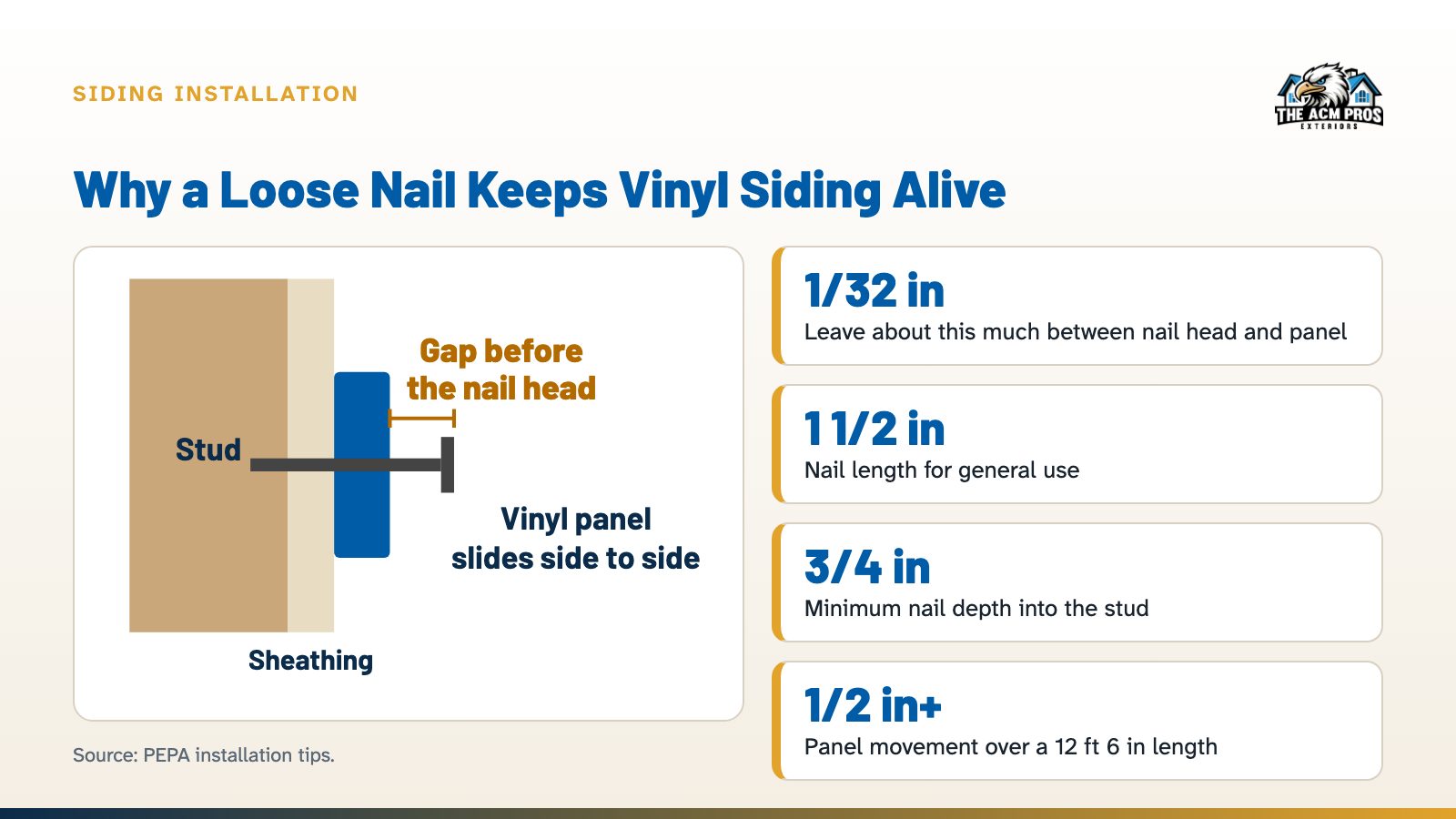
Installation quality affects vinyl siding life by controlling how freely panels expand and contract. The Polymeric Exteriors Product Association (PEPA) says vinyl can move 1/2 in or more over a 12 ft 6 in length.
PEPA directs installers to leave about 1/32 in, roughly the thickness of a dime, between each nail head and the panel. Nails run 1 1/2 in for general use and must reach at least 3/4 in into the stud. Tight nails lock the panel in place and cause buckling when the weather swings.
The diagram below shows the nail gap and the other installation numbers in one place.
How Long Does Vinyl Siding Last in Hot Climates?
Vinyl siding in hot climates lasts closer to the short end of its 20 to 40 year range. Constant sun causes fading and brittleness in the panel.
Humidity and storms add wear, according to published siding guides. Hot summers and storm seasons make shade, clean panels and correct nailing matter more in the South. Reflected light from glass adds a second heat source.
Concentrated sunlight reflected from energy efficient windows can distort or melt siding, according to PEPA. The group calls the problem uncommon and says thickness and color are not major fixes. Shade from trees, window screens and sun shades reduce the risk.
Sunlight also drives the next question.
Does Vinyl Siding Fade Over Time?
Vinyl siding does fade over time, and direct sun is the main cause. Rain, snow, ice and ultraviolet light all contribute, as The Spruce notes.
Manufacturers measure fade in Hunter units, a color-change scale. Westlake warrants as low as 3 Hunter units, and most other makers warrant 4. Our color chart guide covers how each shade holds up.
Fading alone does not mean failure, but chalky color paired with brittle panels does. Brittle panels lead into the next problem.
Why Does Vinyl Siding Warp, Buckle or Crack?
Vinyl siding warps, buckles or cracks when heat, tight nails or impact stress the panel. Each cause leaves a different pattern on the wall.
- Tight nails cause waves and buckles across a whole run of panels.
- Reflected sunlight from a window causes localized warping near the glass.
- Hail or thrown objects cause round cracks and holes.
- Age and sun cause brittle edges that crack when touched.
The National Oceanic and Atmospheric Administration's Storm Prediction Center defines severe hail as 1 in or larger. Older panels that lost flexibility can crack under hail of that size. Cracks and holes let water reach the sheathing behind the vinyl.
Water behind the wall is why damage should be caught early.
How Do You Know When Vinyl Siding Needs to Be Replaced?
Vinyl siding needs replacing when damage covers large sections or moisture reaches the wall behind it. One cracked panel can be swapped alone, but widespread damage points to replacement.
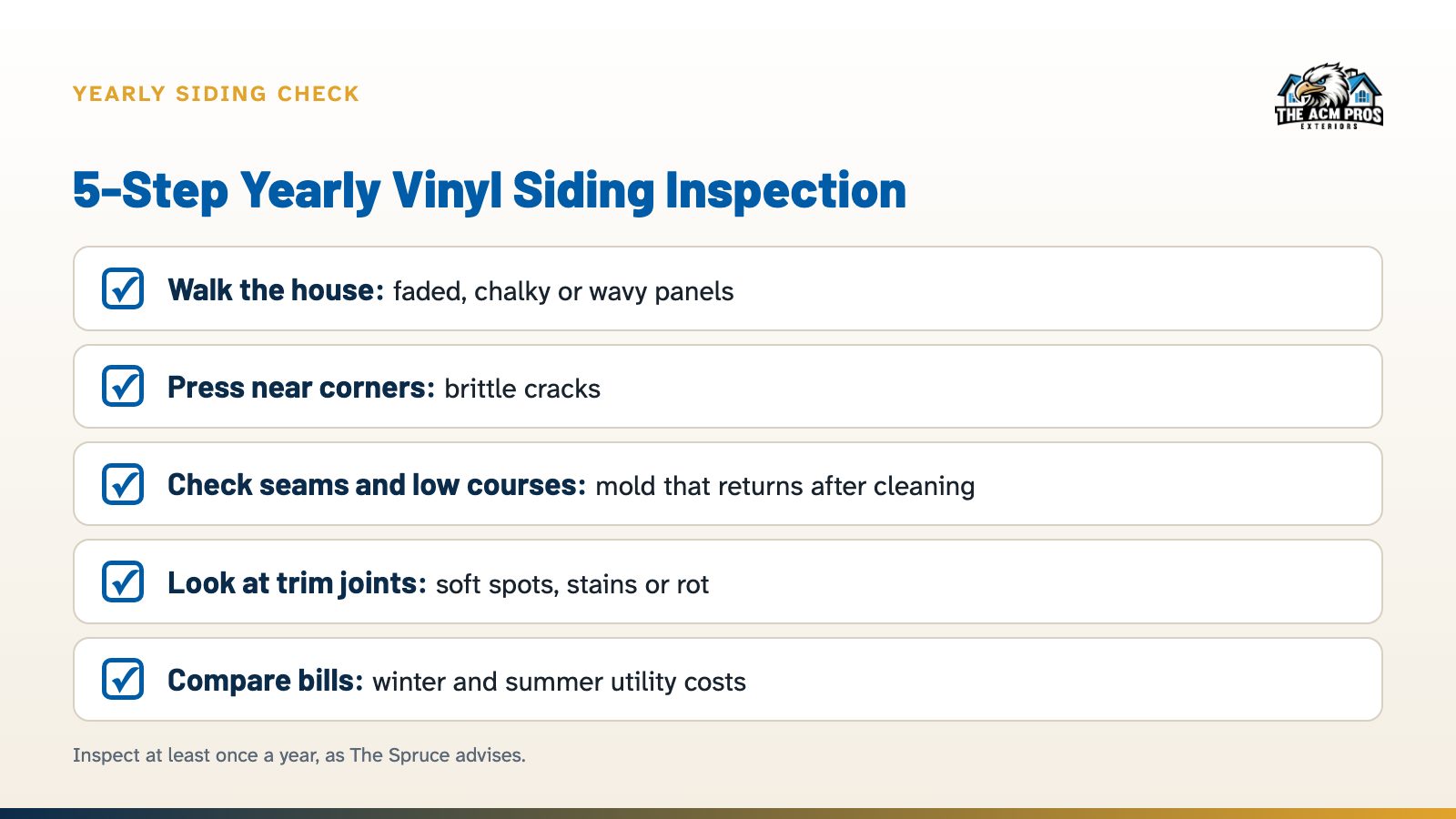
Check the siding in this order each year, using the checklist graphic that follows the steps.
- Walk the house and look for faded, chalky or wavy panels.
- Press on panels near the corners and look for brittle cracks.
- Check seams and the lowest courses for mold that returns after cleaning.
- Look for soft spots, stains or rot where siding meets trim.
- Compare winter and summer utility bills for a rise.
Rot behind panels can reach wall framing. A short inspection helps decide between repair and full replacement.
That decision comes down to scope and cost.
Can You Repair or Paint Vinyl Siding Instead of Replacing It?
You can repair or paint vinyl siding when damage stays limited to a few panels and the wall behind is dry. Larger failures need replacement.
The table compares the three options.
Repair, Paint or Replace Vinyl Siding
| Option | Fits when | What to know |
|---|---|---|
| Replace one panel | One or two panels are cracked | Matching color and brand matters |
| Paint | Panels are flexible but faded | Vinyl-safe paint only |
| Replace the siding | Damage is widespread or moisture is present | Fixr lists $6,000 to $24,000 |
Painted vinyl needs repainting about every 5 to 10 years, according to The Spruce. Fixr warns that the wrong paint can damage vinyl and void a warranty. Replacement cost depends on house size and grade. A full siding upgrade also allows a thicker panel.
Replacement price raises a bigger question, which is what each year of siding life costs.
How Much Does Vinyl Siding Cost per Year of Life?
Vinyl siding costs about $300 to $600 per year of life on a $12,000 average replacement. Fixr publishes that average.
The low figure divides $12,000 by 40 years, and the high figure divides it by 20 years. The table shows the same division at 20, 30 and 40 years, plus the $6,000 low end of Fixr's range.
Cost per Year of Life for a Vinyl Siding Replacement
| Replacement price | 20 years | 30 years | 40 years |
|---|---|---|---|
| $6,000 | $300 | $200 | $150 |
| $12,000 | $600 | $400 | $300 |
Each added year of life lowers the yearly cost. A $12,000 job that reaches 40 years costs $300 a year instead of $600. A 2,000 sq ft house gives a second worked example. Fixr lists vinyl at $3 to $12 per sq ft installed, which puts that house at $6,000 to $24,000.
Care is the cheapest way to move a wall from the 20-year column to the 40-year column, so upkeep comes next.
How Can You Make Vinyl Siding Last Longer?
You can make vinyl siding last longer by washing it once a year and fixing small damage quickly. PEPA says a simple wash with mild soap and water keeps vinyl clean.
- Wash with a soft brush and garden hose, using a basic cleaning solution from the cleaning guide.
- Hire low-pressure washing for tall walls or heavy algae.
- Trim shrubs back so air reaches the panels.
- Inspect panels at least once a year, as The Spruce advises.
- Replace cracked panels before water reaches the sheathing.
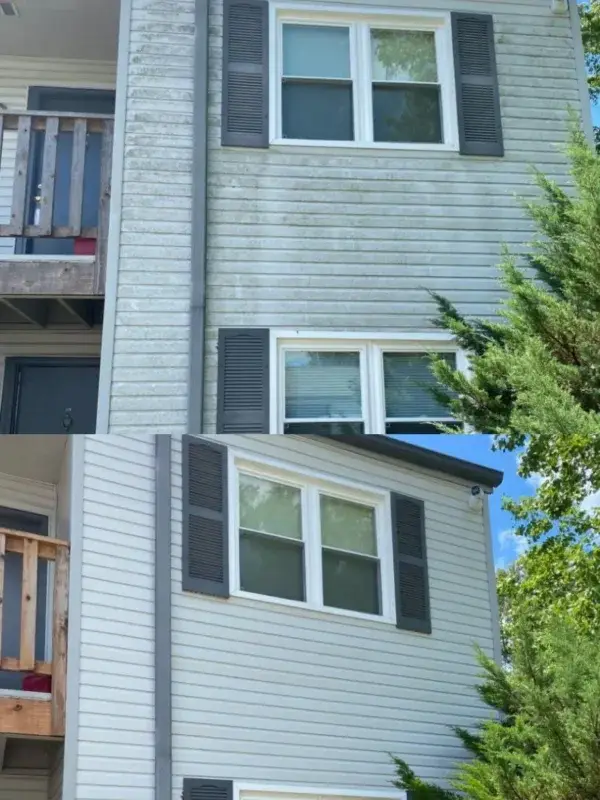
Algae growth responds to a low-pressure house wash that protects the finish. Good upkeep can add years to any panel.
Siding materials differ in how much upkeep they need, which is the next comparison.
How Long Does Vinyl Siding Last Compared With Other Siding?
Vinyl siding lasts 20 to 40 years, while fiber cement reaches 50 years and steel 50 or more. Wood and aluminum fall close to vinyl.
Siding Lifespan by Material
| Siding | Typical lifespan | Source |
|---|---|---|
| Vinyl | 20 to 40 years | Fixr, The Spruce |
| Aluminum | 30 to 40 years | Fixr |
| Wood | 20 to 40 years | Fixr |
| Fiber cement | 50 years | Fixr |
| Steel | 50+ years | Fixr |
Vinyl has the lowest installed cost of any cladding, according to PEPA. Homeowners who want a longer-lived option can compare fiber cement siding, a 50-year material in the same table.
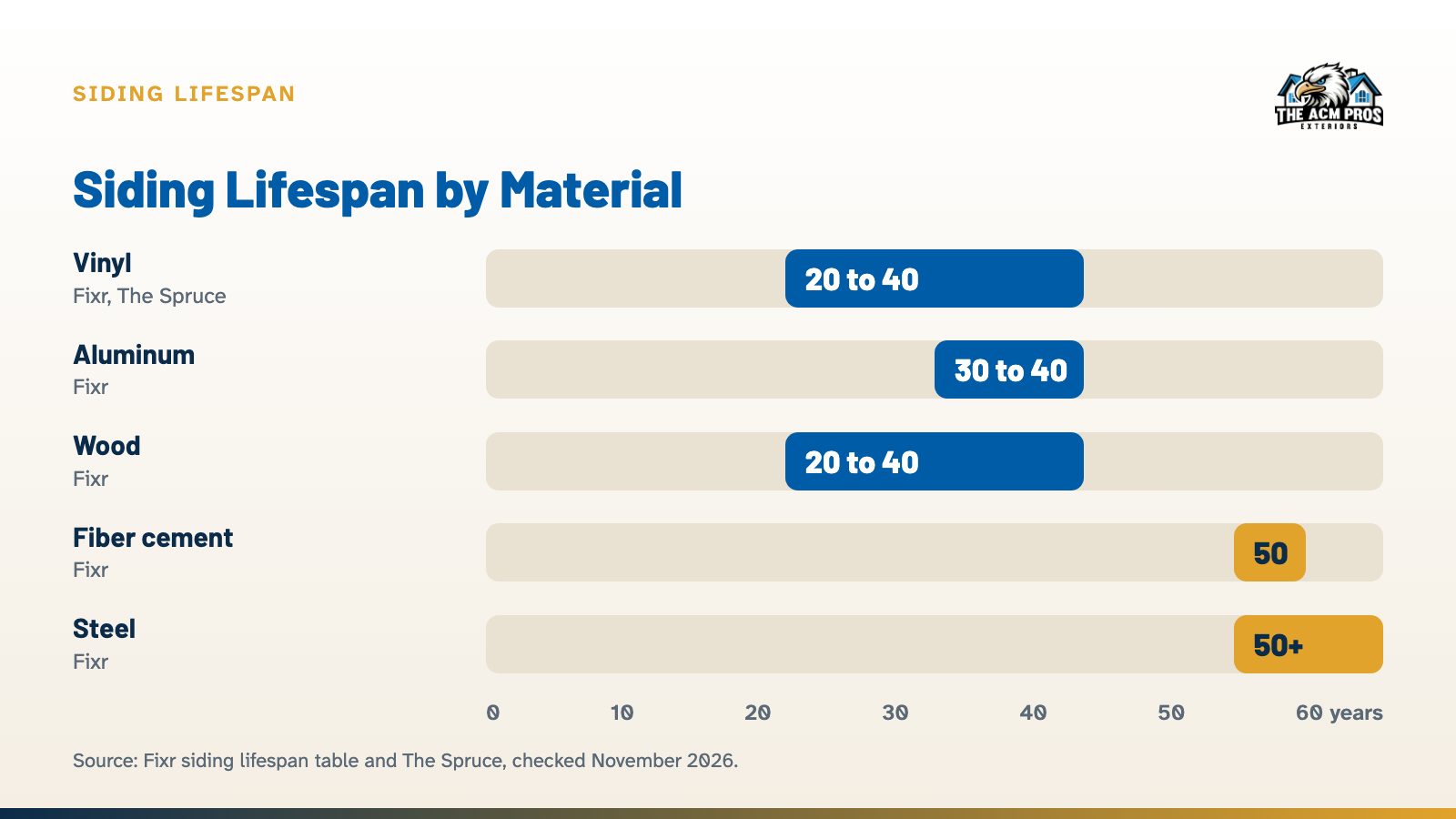
The chart repeats the table at a glance. Several myths still surround these numbers.
What Are the Most Common Vinyl Siding Myths?
Common vinyl siding myths cover lifespan, upkeep, melting and nailing. The table pairs each myth with the documented fact.
Vinyl Siding Myths and Documented Facts
| Myth | Documented fact | Source |
|---|---|---|
| Vinyl siding lasts forever | Plan for 20 to 40 years, with 60+ only under frequent care | The Spruce |
| Vinyl siding needs no upkeep | No painting is needed, but a yearly wash and inspection are advised | PEPA, CertainTeed |
| Sun alone melts vinyl siding | Melting traces to light reflected from energy efficient windows, and PEPA calls it uncommon | PEPA |
| Thicker or lighter panels fix reflection damage | Thickness and color are not major factors | PEPA |
| Nails should sit snug against the panel | Leave about 1/32 in so panels can move | PEPA |
| Every source gives the same lifespan | Published figures run from 25 to 60 years | Fannie Mae, InterNACHI |
Each correction points back to movement, sun or upkeep, the same forces behind the numbers in the next section.
What Are the Key Vinyl Siding Lifespan Numbers?
The key vinyl siding lifespan numbers span 20 to 40 years of life and a 1/32 in nail gap. Each figure below comes from a named source.
- 20 to 40 years: the planning range for vinyl siding (a siding guide).
- 20 to 30 years: standard vinyl siding (Fixr).
- 30 to 40 years: average vinyl siding, with 60+ years under frequent care (The Spruce).
- 0.040, 0.042 and 0.046 in: builder, standard and premium panel thickness (Fixr, Bob Vila).
- 1/2 in or more: panel movement over a 12 ft 6 in length (PEPA).
- 1/32 in: the nail clearance that lets panels move (PEPA).
- 1 in: the hail diameter classed as severe (NOAA Storm Prediction Center).
- 600 to 790 degrees F: the ignition temperature of vinyl (PEPA).
- ASTM D3679: the standard that certified panels meet for weatherability, wind load and impact resistance (PEPA).
- $12,000: the average replacement price (Fixr).
These figures frame every answer above, and a few side questions follow.
What Else Should You Know About Vinyl Siding?
Does Vinyl Siding Last Forever?
Vinyl siding does not last forever, but frequent care can take it past 60 years. The Spruce gives that figure. Weather and impact still wear panels down, so owners who ask how long should vinyl siding last should plan for replacement.
How Long Does Insulated Vinyl Siding Last?
Insulated vinyl siding lasts about as long as its vinyl face, because rigid foam is permanently attached to the back. PEPA describes this construction. Sun and impact still age the outer surface.
Does Thicker Vinyl Siding Last Longer?
Yes, thicker vinyl siding lasts longer, and premium grade at 0.046 in has the longest expected life. Standard grade measures 0.042 in and builder grade 0.040 in. Thicker panels cost more upfront.
Can Hail Damage Vinyl Siding?
Hail can damage vinyl siding, and hail of 1 in or larger is classed as severe by the Storm Prediction Center. Older panels crack more easily than flexible new ones.
Does Vinyl Siding Burn?
Vinyl siding does not ignite easily, because its ignition temperature is about 600 to 790 degrees F. PEPA notes that wood ignites at a lower temperature than vinyl.
Is Vinyl Siding Recyclable?
Vinyl siding is recyclable, and PEPA runs a recycling collaborative called Revinylize. Availability of drop-off points varies by community, so ask a local recycler first.
What Are the Disadvantages of Vinyl Siding?
The main disadvantages of vinyl siding are a shorter lifespan than fiber cement, fading and vulnerability to hail. Panels also expand with heat and can distort from reflected sunlight.
The benefits balance these points. PEPA lists the lowest installed cost, no painting and resistance to rot and insects.
Frequently Asked Questions
How Often Should Vinyl Siding Be Cleaned?
Vinyl siding should be cleaned once a year. CertainTeed recommends a soft brush, mild soap and a garden hose for dirt and pollen.
Why Does Vinyl Siding Turn Green?
Vinyl siding turns green because algae and mildew grow on damp, shaded panels. A mix of 70 percent water and 30 percent white vinegar treats light growth.
Can You Patch Vinyl Siding?
You can patch vinyl siding by replacing the damaged panel rather than filling the hole. The Spruce says one or two boards can be swapped while the rest stay in place.
How Much Does It Cost to Replace Vinyl Siding?
Replacing a home's siding with new vinyl costs $6,000 to $24,000. Fixr publishes that range with a $12,000 average, and house size, grade and wall condition move the final number.
Does Vinyl Siding Need to Be Painted?
Vinyl siding does not need to be painted, because it requires no painting to stay vibrant. PEPA makes the same point, and paint only becomes an option once color fades.
How Can The ACM Pros Help With Your Vinyl Siding?
We inspect siding, repair rotted framing behind it and replace full walls for homes across North Alabama and Middle Tennessee. Our crews check trim, flashing and wall sheathing before any new panel goes up. That inspection shows whether repair or replacement fits your house.
Photos of past siding jobs show finished walls on real homes. Siding choices include vinyl and fiber cement, in a range of colors and profiles. Each wall gets a plan based on its own condition.
Homeowners can request a no-cost estimate for siding repair or replacement. The visit covers panel condition, trim, flashing and moisture behind the wall. Estimates are free and written, and they show how much life is left in your siding. Our crews explain the findings in plain terms.
Brad and Chase Miller lead our installation crews. The family business in Madison, Alabama, is licensed, insured and active since 2019. Siding sits beside windows, doors, roofing and washing among the services we offer to local homeowners.
Call us at (256) 585-6817.