Does Homeowners Insurance Cover Roof Replacement?
Yes, homeowners insurance covers roof replacement when a sudden event like hail, wind, fire or a falling tree damages the roof. Policies exclude age, wear and neglect, so a roof past 20 years may pay only actual cash value.
By the ACM Pros team, Madison, AlabamaPublished 13 minute read
Yes, homeowners insurance covers roof replacement when a sudden event like hail, wind, fire or a falling tree damages the roof. Policies exclude age, wear and neglect, so a roof past 20 years may pay only actual cash value. Wind and hail deductibles can run 1% to 10% of dwelling coverage. That deductible sets how much of the new roof you pay yourself.
Key Takeaways
- Covered perils such as hail, windstorms, fire and falling trees can trigger a full roof replacement.
- Wear, age, neglect, floods and earthquakes are not covered by a standard policy.
- Roofs 15 to 20 years old can be limited to actual cash value, which subtracts depreciation.
- Wind and hail deductibles can reach 1% to 10% of dwelling coverage in some states.
- A repair estimate under your deductible usually means filing a claim will not help.
Does Homeowners Insurance Cover Roof Replacement After Storm Damage?
Yes, homeowners insurance covers roof replacement after storm damage when a covered peril such as hail, wind or fire hits the roof. The dwelling coverage on a standard policy treats the roof as part of the house. An adjuster decides whether the damage calls for a repair or a full replacement.
Insurers pay for the result of a storm and do not pay for the slow decline of an old roof. Homeowners planning a storm roof replacement should confirm the cause with the insurer before work starts. The table below shows how common causes are treated under home insurance roof replacement rules.
Roof Damage Causes and How Homeowners Insurance Treats Them
| Cause of Damage | Covered? | Reason |
|---|---|---|
| Hail | Yes | Sudden storm event |
| Windstorm or tornado | Yes | Sudden storm event |
| Fire or lightning | Yes | Named peril in the policy |
| Falling tree or branch | Yes | Impact from a storm or accident |
| Age and wear | No | Maintenance is the owner's job |
| Neglected leaks | No | Gradual damage is excluded |
| Flood or earthquake | No | Needs a separate policy |
Every row in the table depends on the exact wording of your policy. The next section explains which roof damage counts as covered.
What Roof Damage Does Homeowners Insurance Cover?
Homeowners insurance covers roof damage from sudden, covered perils such as hail, windstorms, tornadoes, fire, lightning and falling objects. Wind and hail accounted for 46.4% of homeowners insurance losses in 2024, according to Triple-I and Verisk ISO data. About one in 34 insured homes files a wind or hail claim each year. The NOAA Storm Prediction Center defines severe hail as stones 1 inch or larger.
Investopedia notes that a covered event can qualify the roof for a total or partial replacement. A tree that lands on the roof during a storm falls under the same dwelling coverage. Water damage inside the home is also covered when a covered peril opens the roof first.
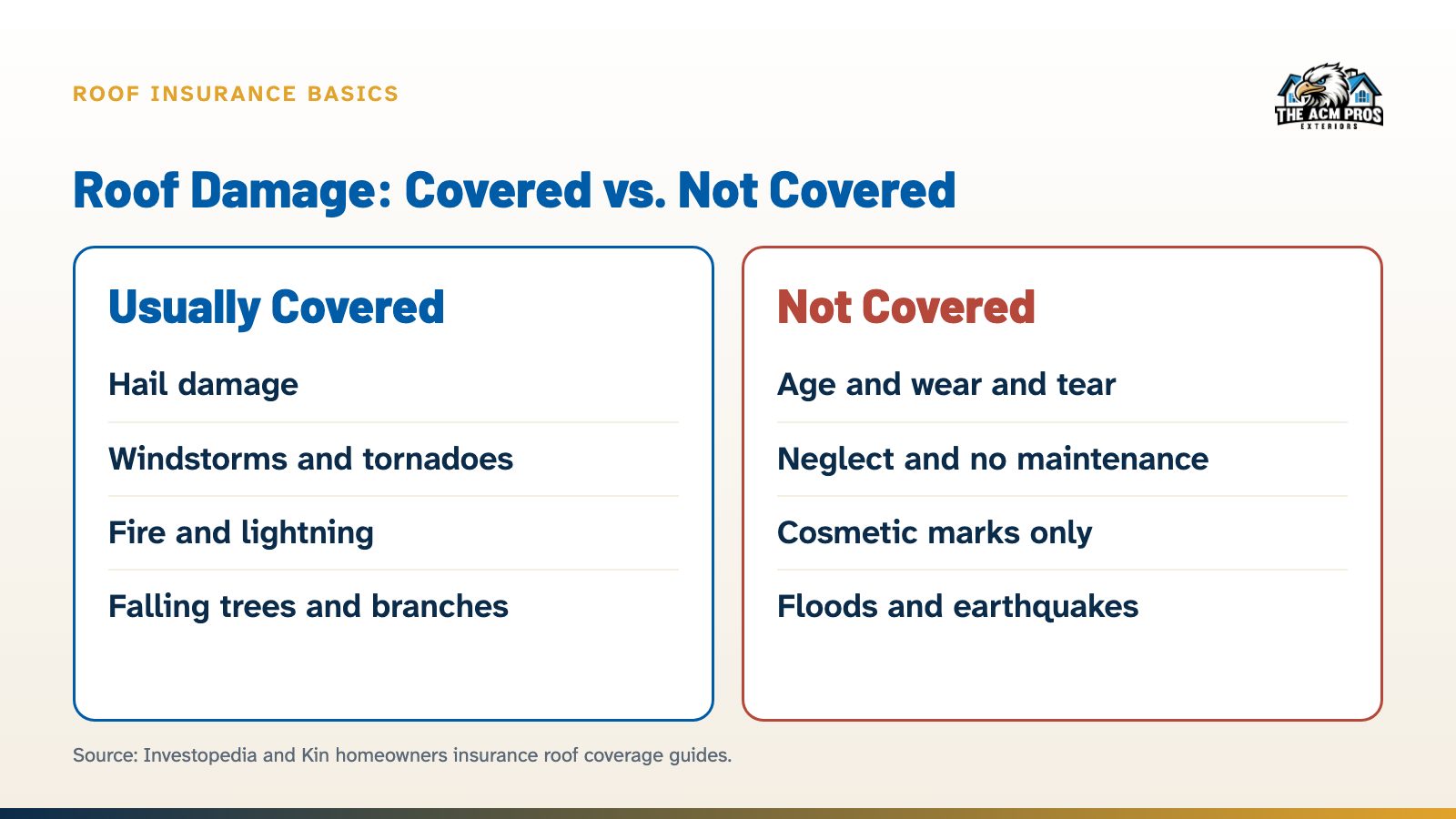
The infographic above sorts common roof damage into covered and excluded causes. The exclusions deserve their own look, because they decide whether a claim is paid.
What Does Homeowners Insurance Not Cover on a Roof?
Homeowners insurance does not cover roof damage from age, wear and tear, neglect or poor maintenance. Granule loss, brittle shingles and slow deterioration all fall in this group. Floods and earthquakes need separate policies, and a standard policy excludes both.
Insurers also separate cosmetic damage from functional damage. A storm that dents metal flashing without letting water in may be classed as cosmetic and denied. A leak that appears after a storm may be blamed on gradual wear.
- Wear and tear from sun, heat and age
- Leaks from skipped maintenance or old unrepaired damage
- Cosmetic marks that do not affect function
- Flood and earthquake damage without a separate policy
Blocked roof vents trap heat and moisture and shortens shingle life, which insurers treat as a maintenance issue. Age is the exclusion that needs a closer look, so it comes next.
Does Homeowners Insurance Cover Roof Replacement Due to Age?
No, homeowners insurance does not cover roof replacement due to age alone, because age is a maintenance matter. A covered storm can still trigger a claim on an old roof. The payout on that claim shrinks as the roof ages.
Insurance for roof replacement narrows with age. Roofs over 20 years old are often insured at actual cash value only, according to Investopedia. Kin states that coverage may be limited once a roof reaches 15 to 20 years. Material matters as well, since roof lifespans range from 15 to 150 years.
Is a 20 Year Old Roof Insurable?
A 20 year old roof is insurable, but the policy may carry stricter terms. Policygenius says most insurers require an inspection when an application lists a roof over 20 years old. Some insurers will not write a new policy on roofs that are 15 or 20 years old.
Insurers that do write the policy may limit the roof to actual cash value. Replacing a worn roof before a storm removes that limit.
How Do Insurance Companies Know How Old Your Roof Is?
Insurance companies learn your roof's age from the answers on your application and from inspections. Policygenius notes that an application listing a roof over 20 years old usually triggers an inspection. Keep the installation date and receipts from your roofer on file.
An asphalt shingle roof typically lasts 15 to 20 years. Tile or slate can last 50 years or more, based on Compare.com data. Those lifespans explain why insurers treat age differently by material.
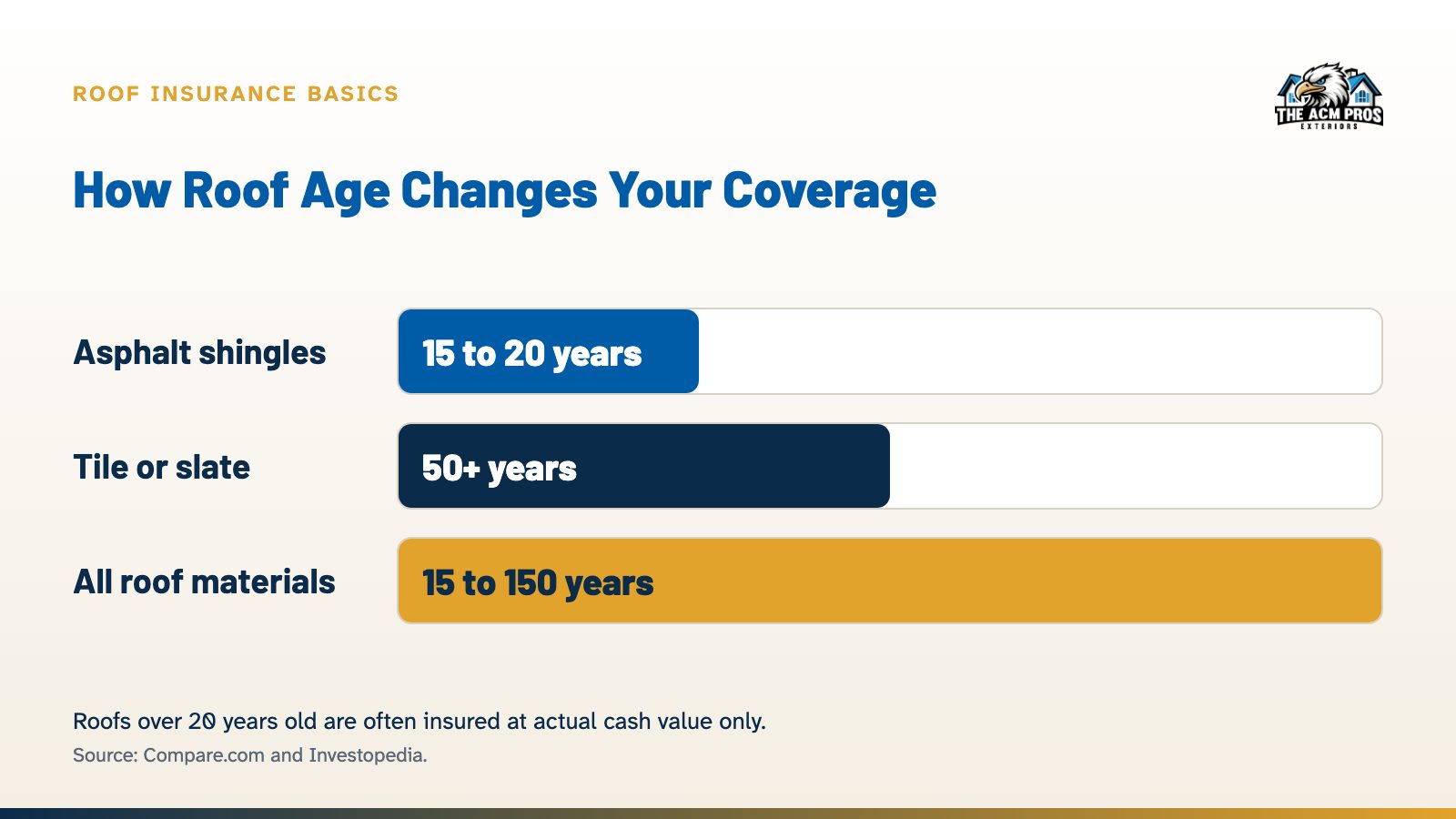
The bar chart above compares roof lifespan by material against the 15 to 20 year range where coverage starts to narrow.
What Is the Difference Between ACV and RCV Roof Coverage?
Actual cash value (ACV) pays the roof's depreciated value. Replacement cost value (RCV) pays the full cost to replace it with similar materials. Both subtract your deductible. ACV depreciates the roof for age and wear, so older roofs receive smaller checks.
Some policies limit roof claims to ACV even when RCV applies to the rest of the home. Kin also describes a scheduled loss, also called a roof surface payment schedule. That setup pays a set percentage of replacement cost based on roof age.
Roof Payout Types Compared: ACV, RCV and Scheduled Loss
| Payout Type | What It Pays | Effect on Older Roofs |
|---|---|---|
| Actual cash value | Replacement cost minus depreciation | Lowest payout |
| Replacement cost value | Current cost to replace, minus deductible | Highest payout |
| Scheduled loss | Set percentage based on roof age | Payout falls each year |
The table shows why payout type matters as much as the cause of damage. Roof replacement insurance coverage of any kind starts with the declarations page, which states which type applies to your roof.
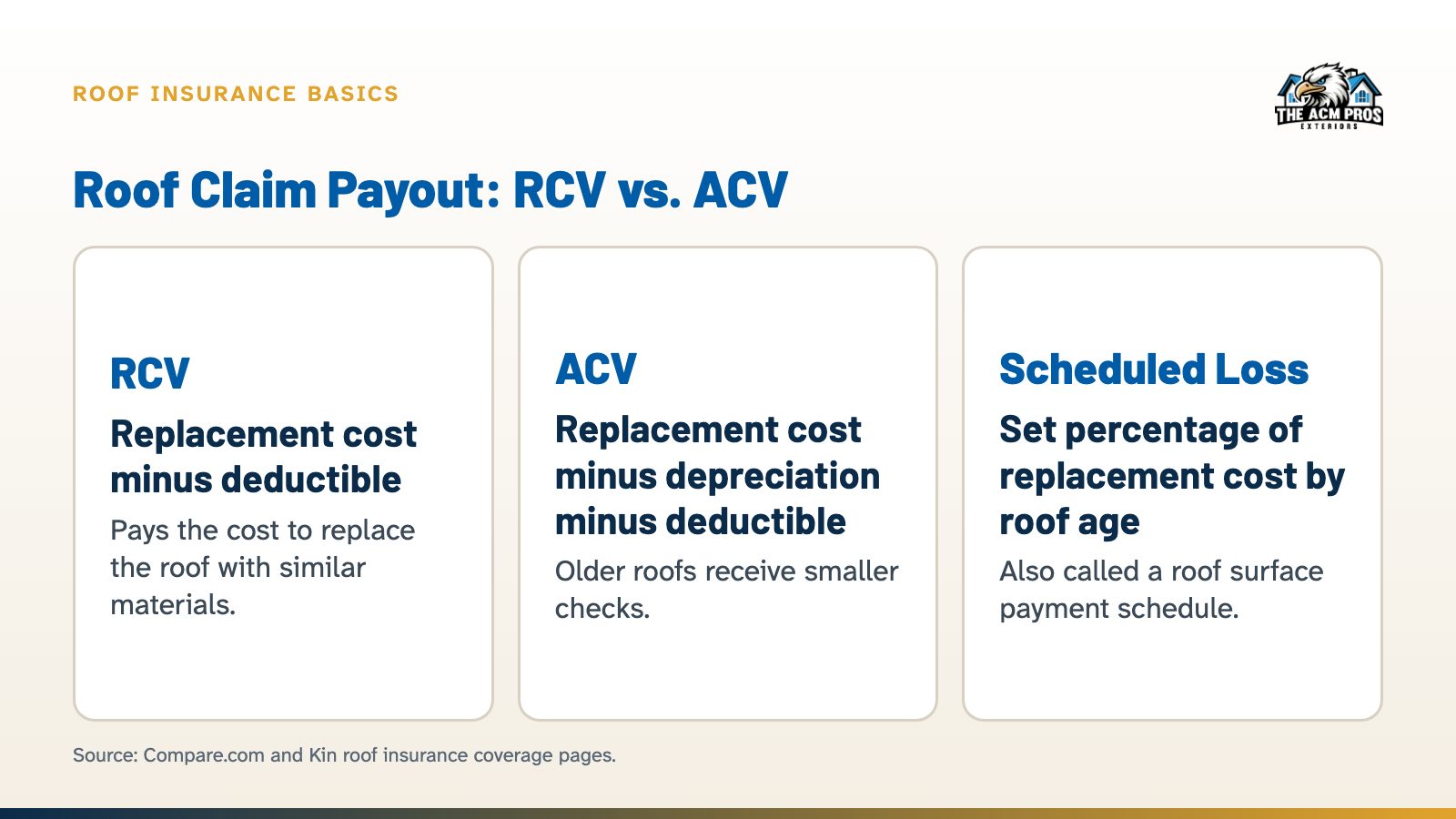
The graphic above shows the two payout formulas side by side. Your deductible is the next number that changes the check.
How Does a Deductible Work on a Roof Replacement Claim?
A roof deductible is the amount you pay first. It can be a flat dollar amount or a percentage of dwelling coverage. Compare.com gives a $2,500 flat deductible as an example. You pay that amount before insurance covers the remaining approved cost.
Wind and hail deductibles can be set at 1% to 10% of dwelling coverage, according to Policygenius. A home insured for $300,000 with a 1% wind and hail deductible leaves $3,000 for the owner. Hurricane deductibles are often 1% to 5% of insured value.
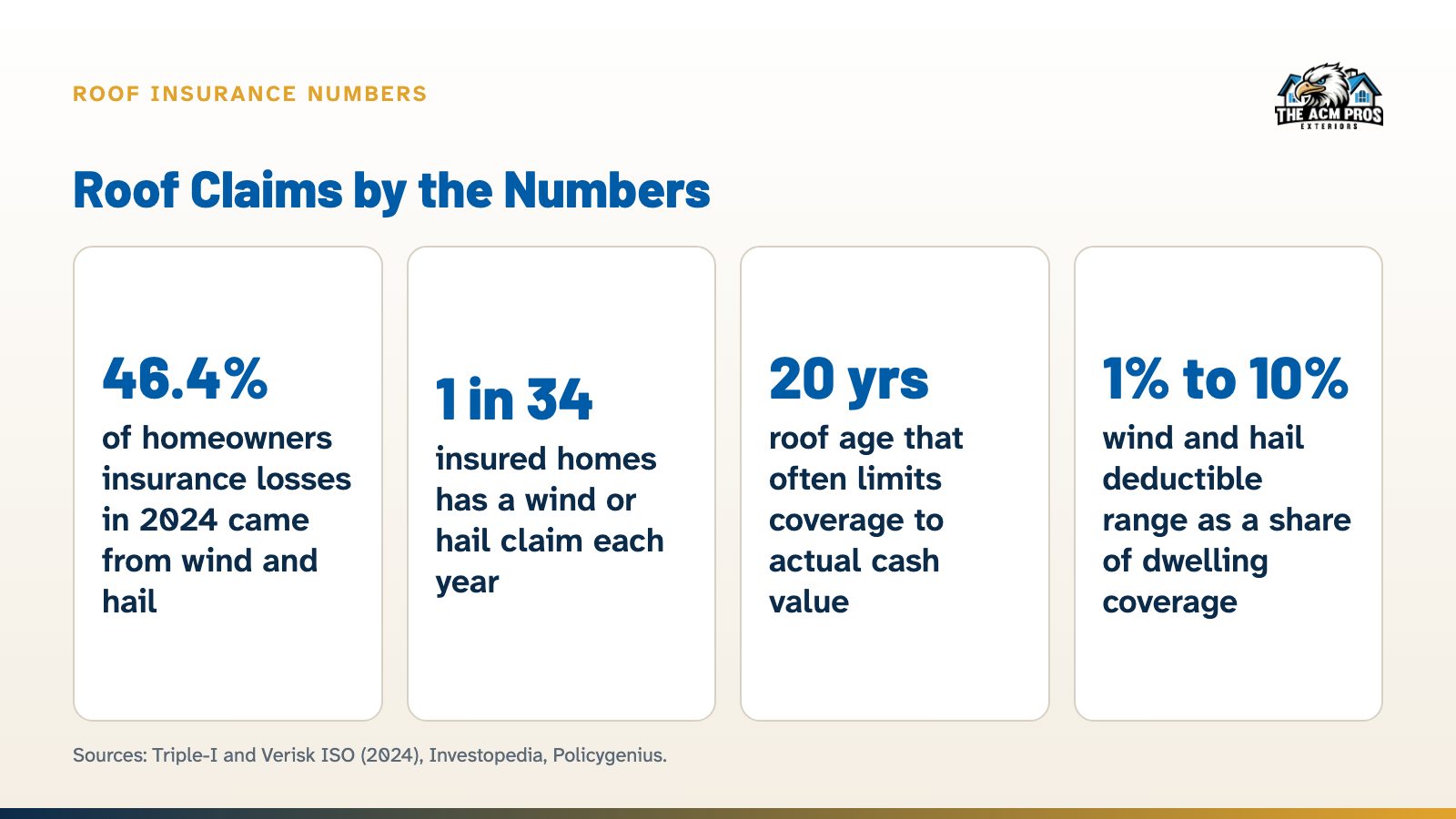
These four numbers frame a roof claim. A claim only helps when the approved cost clears the deductible by a wide margin.
How Much Does Insurance Pay for a Roof Replacement?
Insurance pays the approved replacement cost minus your deductible, and actual cash value also subtracts depreciation. The National Association of Insurance Commissioners (NAIC) shows a $15,000 roof loss with a $1,000 deductible. Replacement cost coverage pays $14,000 in that example, while actual cash value pays $4,000.
Roof Claim Payout Example: $15,000 Loss With a $1,000 Deductible
| Coverage Type | Depreciation Subtracted | Deductible | Insurer Pays |
|---|---|---|---|
| Replacement cost value | $0 | $1,000 | $14,000 |
| Actual cash value | $10,000 | $1,000 | $4,000 |
The gap between the two rows is $10,000, and it comes entirely from depreciation. The next question covers what the owner pays in each case.
How Much Do You Pay Out of Pocket After a Covered Roof Claim?
Your out-of-pocket cost equals the deductible plus any depreciation the policy does not repay. In the NAIC example, the owner pays $1,000 with replacement cost coverage and $11,000 with actual cash value. A $300,000 home with a 1% wind and hail deductible adds $3,000 to the owner's share, according to Policygenius.
Roof cost sets the scale for those numbers. NerdWallet puts the average roof replacement at about $9,500. National roofing cost guides give $8,000 to $22,000 for a 2,000-square-foot roof with standard materials. A deductible near those figures can leave a small check or none.
How Do You File a Roof Replacement Claim?
You file a roof replacement claim by documenting the damage and contacting your insurer promptly. Investopedia advises gathering your policy, inspection reports, repair receipts and photos of the damage. Photos of the roof before the storm also help.
- Take photos and video of the damage when it is safe.
- Stop leaks with a tarp and keep the receipts.
- Contact your insurer and open the claim.
- Meet the adjuster at the home during the inspection.
- Compare the adjuster's estimate with a written roofer estimate.
Compare.com warns about contractors who promise free roofs or waived deductibles. Those promises are red flags for home repair fraud. The full process has its own guide on filing a claim for readers who want every step.
What Should You Gather Before Filing a Roof Claim?
Before you file a roof claim, gather the policy, photos and a written roofer estimate. Investopedia lists the policy, inspection reports, repair receipts and damage photos as the core documents. Each item shortens the adjuster's review.
- Declarations page showing roof payout type and deductible
- Installation date and receipts for the current roof
- Dated photos and video of the damage
- Storm date and a hail or wind report for your address
- Tarp and temporary repair receipts
How Long Does an Insurance Company Have to Respond to a Roof Claim?
An Alabama insurer must acknowledge a claim within 15 days and accept or deny it within 30 days after proof of loss. Alabama Administrative Code 482-1-125 sets both deadlines, and the 30 days can follow the period the policy states. Other states set their own timelines, so check your state insurance department.
What Do the Numbers Say About Roof Insurance Claims?
Roof insurance claims are common, and wind and hail drive 46.4% of homeowners insurance losses. The figures below come from named insurance, weather and safety sources. They show how often claims happen, what they cost and where the rules differ.
- 46.4% of homeowners insurance losses in 2024 came from wind and hail (Triple-I and Verisk ISO).
- 5.10 claims per 100 house-years in 2024, about 5.1% of insured homes (Triple-I).
- $15,708 average wind and hail claim, a 2020-2024 weighted average (Triple-I).
- 22.2% of 2024 losses came from water damage and freezing, and 19.9% from fire and lightning (Triple-I).
- 1% to 10% of dwelling coverage as a wind and hail deductible (Policygenius).
- 15 to 20 years as the typical asphalt shingle lifespan (Compare.com).
- 1 inch as the size where hail counts as severe (NOAA Storm Prediction Center).
- 15 and 30 days as the Alabama claim response deadlines (Alabama Administrative Code 482-1-125).
- $700 to $1,700 as the sample FORTIFIED roof upgrade cost difference (IBHS).
The $15,708 average wind and hail claim is larger than the $9,500 average roof replacement cost from NerdWallet. The next section turns these figures into a filing decision.
When Does Filing a Roof Insurance Claim Make Sense?
Filing a roof insurance claim makes sense when covered damage costs well above your deductible. The short answer to does homeowners insurance cover roof replacement is yes for sudden damage and no for age. Replacement cost coverage on a storm-damaged roof can pay the full replacement cost. Homeowners insurance roof replacement checks still subtract the deductible. An old roof with ACV coverage may pay little after depreciation and the deductible.
Roof replacement through insurance works only when the claim clears the deductible. The cost of a new roof gives context. Roof replacement averages about $9,500, according to NerdWallet. This Old House puts a shingle roof at $6,885 to $23,993 for a 2,000-square-foot home. An estimate that falls near your deductible leaves little to gain from a claim.
Decision Matrix: When Filing a Roof Insurance Claim Makes Sense
| Situation | File a Claim? | Reason |
|---|---|---|
| Hail or wind damage, estimate far above deductible | Yes | Covered peril and the check clears the deductible |
| Roof under 15 years with replacement cost coverage | Yes | Payout is replacement cost minus deductible |
| Roof over 20 years with actual cash value coverage | Weigh it | Depreciation can shrink the check sharply |
| Estimate close to the deductible | No | The payout is small or zero |
| Wear, age or a neglected leak | No | The cause is excluded |
| Cosmetic marks with no leak | No | Insurers may class it as cosmetic damage |
The matrix gives a quick answer, and the flow below puts the same checks in order.
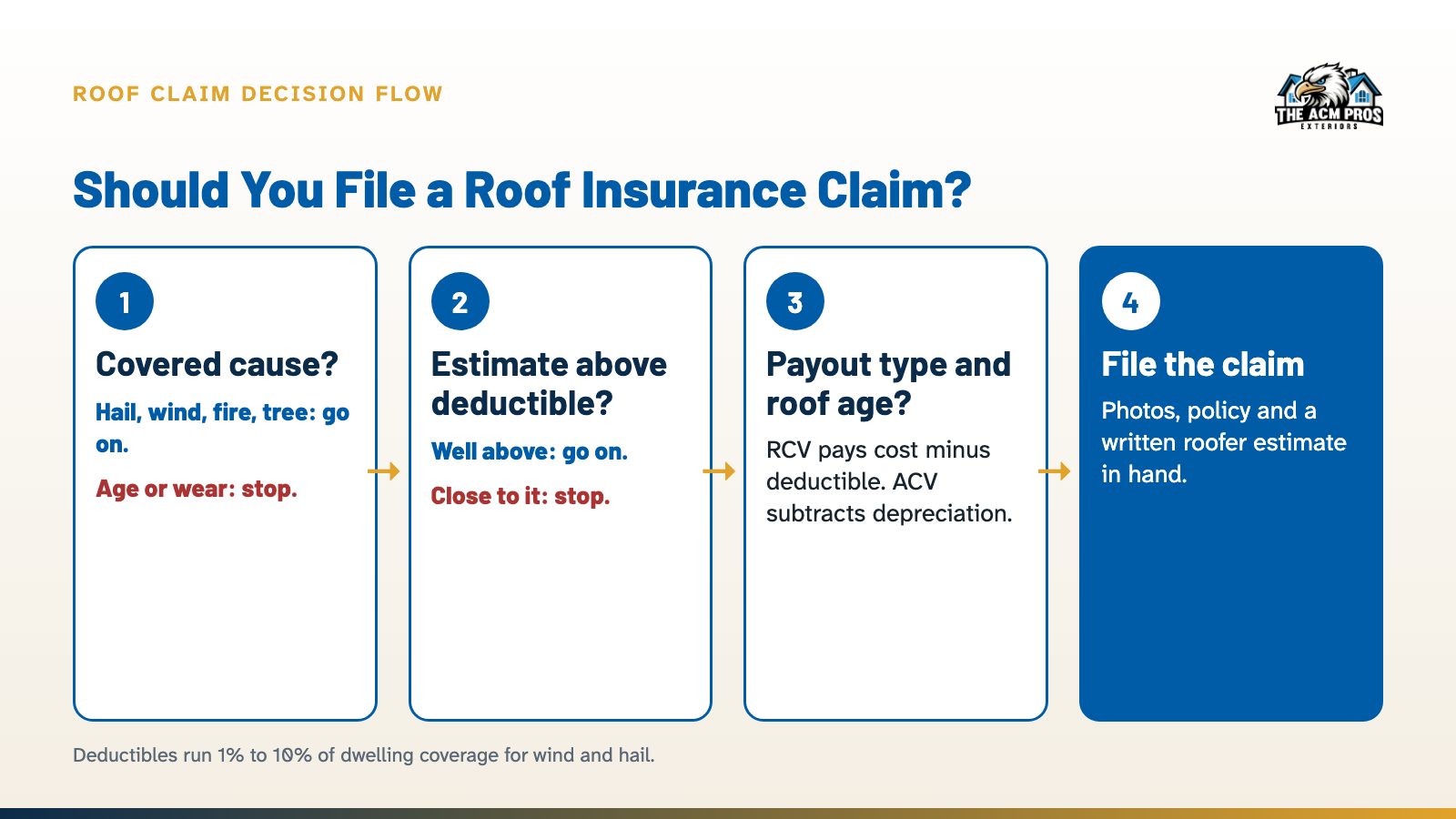
Each check in the flow removes one reason a claim might fail.
A licensed roofing contractor can inspect the roof and write an estimate before you decide. That estimate also tells you whether the damage is repairable.
We recommend an inspection even when you plan a complete tear-off with no claim. A written scope gives you a number to compare with the adjuster's figure.
What Else Should You Know About Roof Insurance Coverage?
What Are Common Myths About Roof Insurance Claims?
Common roof insurance myths include free roofs, covered age and full payouts, and each one fails on the policy facts. The table pairs four myths with the rule behind each fact.
Roof Insurance Myths Versus Facts
| Myth | Fact | Source |
|---|---|---|
| Insurance replaces any old roof | Age and wear are maintenance, not covered perils | Investopedia |
| Every claim pays the full new roof | Actual cash value paid $4,000 on a $15,000 loss | NAIC |
| A roofer can waive your deductible | Waived deductibles are a red flag for repair fraud | Compare.com |
| Every state handles roof coverage alike | Deductibles run 1% to 10% and Alabama requires a FORTIFIED offer | Policygenius, IBHS |
Each fact in the table points back to a figure used earlier. Statements to an adjuster are the next place homeowners slip.
What Not to Say to an Insurance Adjuster About Your Roof?
Never guess at the cause of damage or the age of the roof when you speak with an adjuster. State the facts you know, such as the date of the storm and the damage you saw. Avoid saying the damage is old or that you skipped maintenance, unless it is true and you can document it.
What Not to Tell Your Insurance Company?
Do not tell your insurance company anything you cannot support with records. Give accurate answers about roof age, repairs and prior damage. An inaccurate answer on an application or claim can lead to a denial.
How Much Will My Insurance Go Down If I Get a New Roof?
A new roof can lower your premium, though the amount depends on the insurer. Policygenius notes that many insurers offer wind mitigation discounts for impact-resistant roofs. Compare.com adds that impact-resistant shingles and metal roofs sometimes qualify for discounts in areas prone to wind or hail.
Does Alabama Require Insurers to Offer a FORTIFIED Roof Endorsement?
Alabama requires insurers that write homeowners policies to offer a FORTIFIED Roof endorsement under Section 27-31D-2.1. The endorsement pays the added cost of rebuilding a covered roof to FORTIFIED standards after a covered loss. The Insurance Institute for Business and Home Safety (IBHS) found sample upgrade costs differ by $700 to $1,700.
IBHS research shows 65% of water that hits an exposed roof deck enters the home. A sealed roof deck can cut that intrusion by as much as 95%.
Is Roof Replacement Tax Deductible?
Roof replacement on a primary home is not tax deductible, because the cost raises the home's basis instead. That higher basis can lower taxable gain when you sell. The full breakdown is in our post on roof tax deductions.
What to Do If You Cannot Afford a New Roof?
Homeowners who cannot afford a new roof can fix the worst areas first and compare written estimates. Savings, a home equity loan or an insurance claim for covered damage are the usual funding paths. We do not offer financing, so confirm terms with your lender.
Frequently Asked Questions
Does Insurance Cover Roof Replacement After a Storm?
Insurance covers roof replacement after a storm when hail, wind or another covered peril caused the damage. The adjuster confirms the cause and the extent. Your deductible applies first.
Will Insurance Cover Roof Replacement on an Old Roof?
Insurance will cover roof replacement on an old roof only when a covered event causes the damage. The payout may be actual cash value. Age alone is never covered. Newer roofs fare better under replacement cost coverage.
Is Roof Replacement Covered by Insurance When the Roof Leaks?
Roof replacement is covered by insurance for a leak only when a covered event caused the opening. A leak from wear or skipped repairs is excluded. The cause decides the answer.
What Three Items Are Not Covered by Homeowners Insurance?
Wear and tear, neglect and floods are three items a standard homeowners policy does not cover. Earthquakes also need a separate policy. Maintenance damage stays with the owner.
At What Age Is a Roof Considered Old?
A roof is considered old at 15 to 20 years for asphalt shingles, based on Compare.com lifespans. Insurers start to limit coverage near that range. Tile and slate last 50 years or more.
Will There Be a Tax Credit for Roof Replacement in 2026?
No, the federal Energy Efficient Home Improvement Credit covers only property placed in service through December 31, 2025. A roof installed in 2026 earns no federal credit under that rule. State programs differ.
How Can The ACM Pros Help After Storm Damage to a Roof?
Our team handles full tear-off roof replacement in North Alabama and Middle Tennessee. That includes deck repair, underlayment, flashing and attic ventilation. We are licensed in Alabama and insured, and we quote a repair when a repair is enough. We do not handle insurance claims, so your adjuster decides coverage.
Father and son Brad and Chase Miller have run the company since 2019. A free written estimate gives you the scope of work and a clear number. Compare it with your insurer's figure and your deductible.
Our crew serves homeowners who want straight answers before a storm or after one. Bring your policy and your questions, and we will explain what the roof needs in plain terms.
Ask for a free estimate and we will schedule a roof inspection at a time that suits you. We confirm the visit by phone and keep the written scope simple to read.
Call (256) 585-6817 to talk with the team today.