What Is a Storm Door?
A storm door is a second door mounted in front of an entry door to block rain, wind and snow. The outer door also lets in light and air.
By the ACM Pros team, Madison, AlabamaPublished 14 minute read
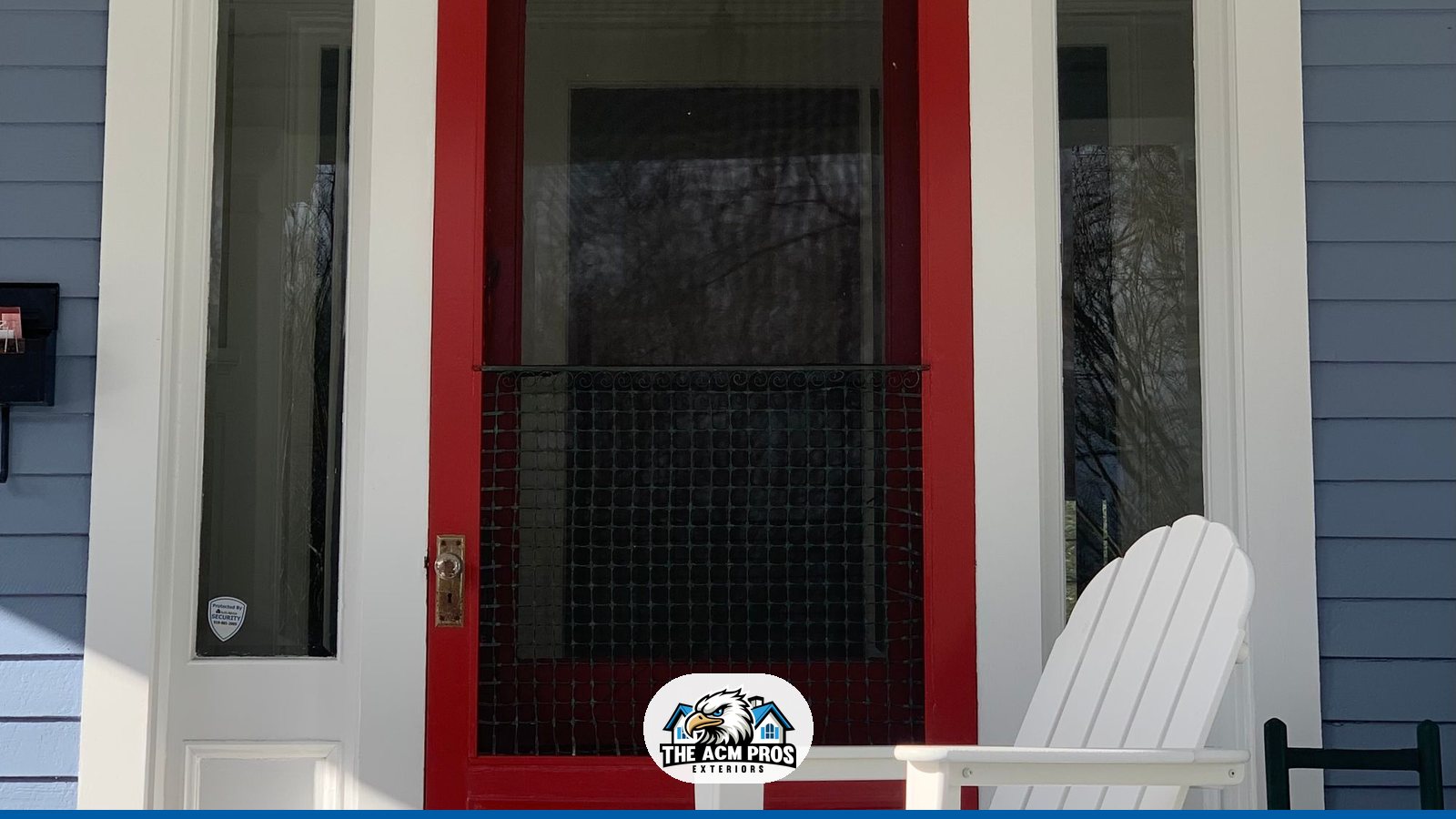
A storm door is a second door mounted in front of an entry door to block rain, wind and snow. The outer door also lets in light and air. Storm doors come in 4 common styles: full-view interchangeable, full-view retractable, three-quarter light and half light. A standard frame needs 3/4 inch of flat trim, 1 inch of trim depth and 2 1/2 inches of frame depth.
Key Takeaways
- A storm door is an outer door that shields the entry door from weather and adds a pocket of still air.
- Four common styles exist: full-view interchangeable, full-view retractable, three-quarter light and half light.
- The US Department of Energy says frames are usually aluminum, steel, fiberglass or wood.
- A newer insulated entry door gains little from a storm door, while an older door in good shape gains more.
- A fit check needs 3/4 inch of flat trim, 1 inch of trim depth and 2 1/2 inches of frame depth.
What Is a Storm Door Used For?
A storm door is used as a second door that blocks bad weather and allows ventilation. The outer door takes the rain, snow and sun, so the entry door behind it keeps its finish. Merriam-Webster defines the term as an additional door placed outside an ordinary outside door for protection against severe weather. A pocket of still air between the two doors also slows heat flow.
The storm door frame mounts to the exterior trim around the entry door, so the entry door itself stays untouched. Proper storm door installation starts with a trim check, which the fit section below explains step by step. Before that, the location of the door deserves a closer look.
What Is a Storm Door on a House?
A storm door on a house is the outer door at an entry that swings outward over the main door. The main door sits behind it and swings inward. A storm door guide notes that a storm door pulls its weight on an exposed doorstep with no porch covering. The next question is what the door actually looks like.
What Does a Storm Door Look Like?
A storm door looks like a lightweight door frame holding a large glass panel, a screen and a solid lower panel. The US Department of Energy says storm door frames are usually aluminum, steel, fiberglass or wood. A closer tube at the top or bottom pulls the door shut, and a handle set sits at hand height.
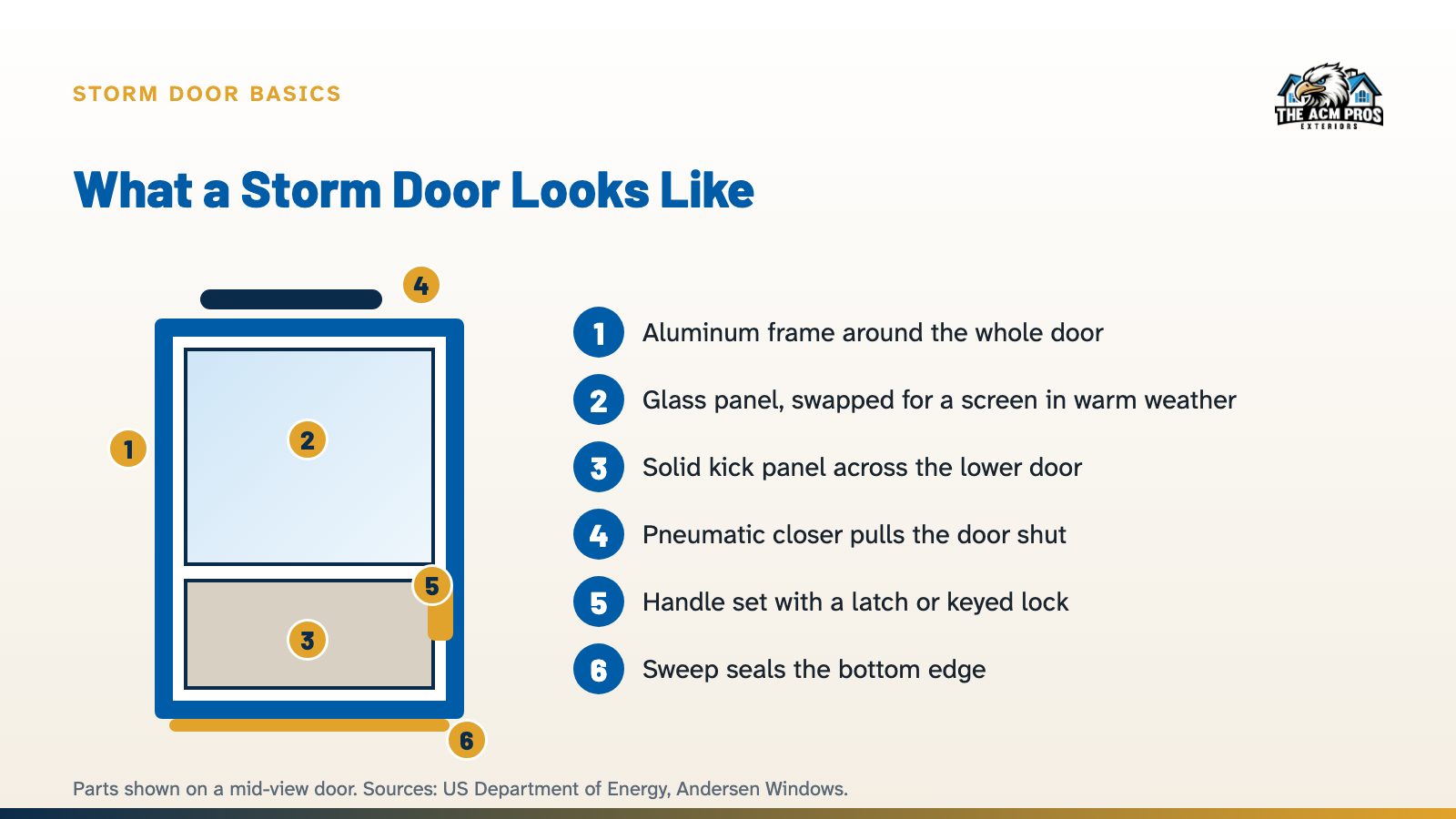
The diagram above labels six parts: frame, glass panel, kick panel, closer, handle set and sweep. The glass panel swaps for a screen in warm weather on interchangeable models. The sweep is a seal along the bottom edge that keeps out water and insects.
Full-view doors show glass from top to bottom, while mid-view doors add a solid panel near the bottom. Andersen Windows offers frame colors that include charcoal gray, so a storm door can match the trim. Style names follow the amount of glass, which leads to the main types.
Why Do Homes Have Storm Doors?
Homes have storm doors to protect the entry door, add insulation, bring in daylight and open the entry to fresh air. Each job comes from the same second layer of frame, glass and screen. The jobs are easiest to compare one at a time.
Weather protection comes first. The storm door takes driving rain, snow and direct sun in place of the entry door, which costs more to replace. Storm door references describe the same barrier against heavy rain, snow and wind.
The air gap between the doors slows heat transfer because still air conducts heat poorly. A storm door guide calls that effect modest, and it matters most when the inner door is older and less insulated. Ventilation is the second benefit of the gap.
A screen panel lets the entry door stay open on a mild day while insects stay out. Full-glass models let daylight into a dark entry. Andersen Windows adds that select models offer a keyed deadbolt and laminated glass for an extra layer of security. The name of the door points back to its oldest job.
Why Is It Called a Storm Door?
A storm door is called a storm door because it first stood outside the entry to block wind, rain and snow. Merriam-Webster dates the first known use of the term storm door to 1878. The word describes the weather job, not the glass or screen inside the frame.
Wood was the original material for storm doors, according to storm door references. Screens came later and added warm-weather airflow, which is why storm doors and screen doors get mixed up. The material list shows how far the frames have moved beyond wood.
What Are the Main Types of Storm Doors?
The main types of storm doors are full-view interchangeable, full-view retractable, three-quarter light and half light. Andersen Windows names each style for the amount of glass in the panel. Storm door guides group the same designs into full-view, retractable screen and ventilating types.
Storm Door Styles Compared
| Style | Glass Coverage | Screen Type | Good Match |
|---|---|---|---|
| Full-view interchangeable | Full height | Glass swaps for a screen by hand | Entries that need daylight |
| Full-view retractable | Full height, split in two | Screen pulls down from the top | One-handed airflow |
| Three-quarter light ventilating | Three-quarters of the door | Built-in screen, no swapping | Light plus a sturdier lower panel |
| Half light ventilating | Half of the door | Built-in screen, no swapping | Pet door space and privacy |
The table shows that glass coverage and screen type are the two choices that separate the styles. Andersen Windows says the half light style leaves room for a pet door at the bottom. The infographic below repeats the four styles at a glance.
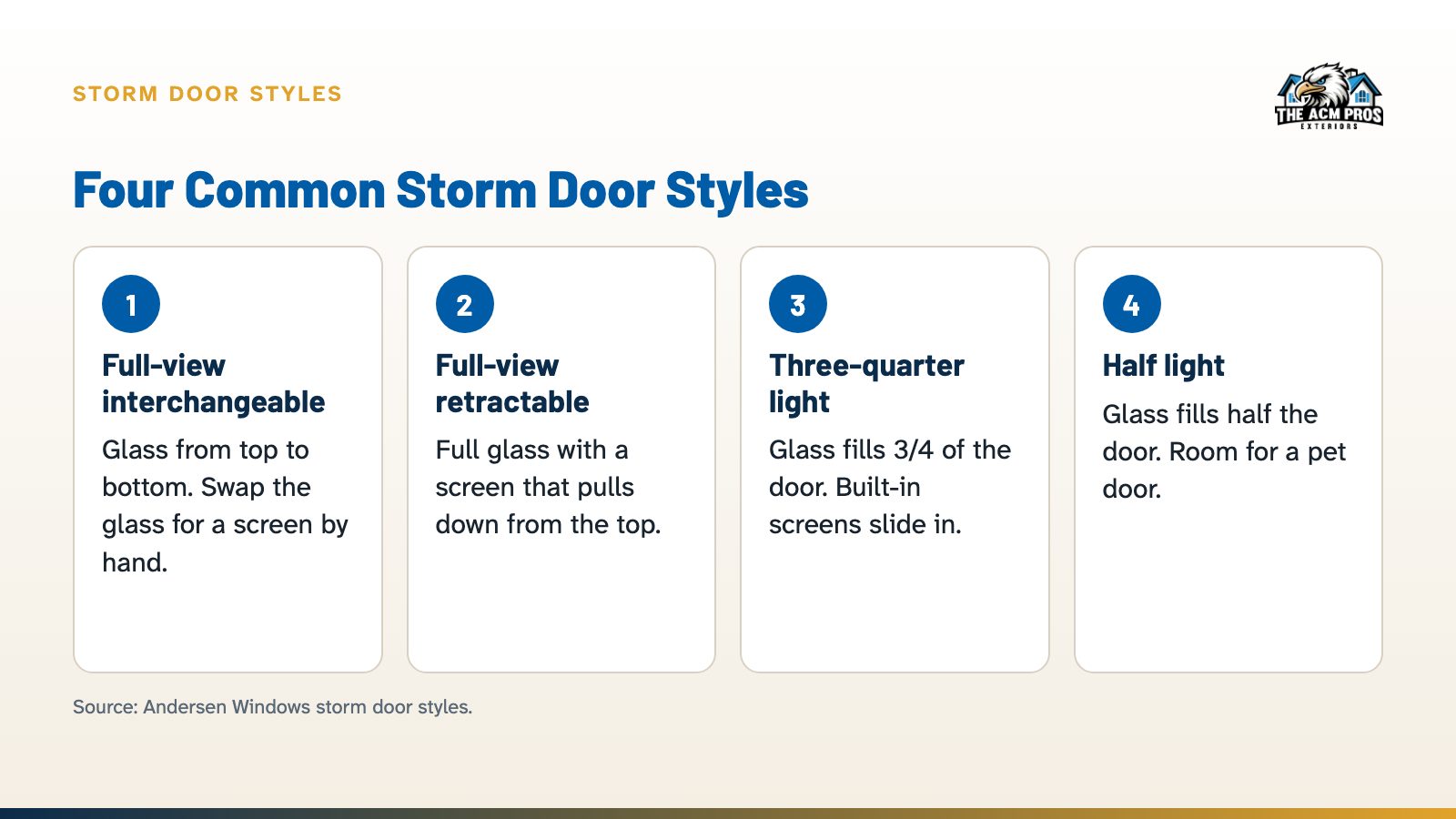
Full-view doors let in maximum daylight, but a solid lower panel takes scuffs from feet, pets and snow shovels. A storm door guide makes that point about mid-view doors. The screen design deserves its own answer.
What Is a Retractable Screen Storm Door?
A retractable screen storm door is a storm door with an insect screen that rolls into the frame when not in use. Storm door guides describe the screen as rolled up inside the frame. Andersen Windows says one hand can pull it down from the top. A storm door guide notes that retractable models cost more, but nothing has to be stored in the garage. Frame materials come next.
What Materials Are Storm Doors Made From?
Storm doors are made from aluminum, vinyl, fiberglass, wood or steel. The US Department of Energy adds that wooden storm doors need more maintenance than the other types. Metal frames can also hold foam insulation, and better doors use low-emissivity (Low-E) glass.
Storm Door Frame Materials Compared
| Material | Main Strength | Upkeep |
|---|---|---|
| Aluminum | Resists corrosion and stays light | No frequent painting |
| Vinyl (PVC) | Resists corrosion, can mimic wood grain | No painting, even if scratched |
| Fiberglass | Very strong frame | No painting, costs more |
| Wood | Original storm door material | Needs paint or another coating |
Storm door guides support the rows in this table. Thicker frames are more rigid in every material, and aluminum corners can crack if the door blows open in a storm. Steel frames are heavier and more secure, according to a storm door guide. Glass and screen choices lead to the comparison with screen doors.
What Is the Main Difference Between a Screen Door and a Storm Door?
The main difference between a screen door and a storm door is glass and weather protection. A storm door adds both, while a screen door only blocks insects. A storm door guide makes the same split. A storm door converts to a screen on models with swappable or built-in panels, so one frame serves both seasons.
Storm Door vs Screen Door
| Feature | Storm Door | Screen Door |
|---|---|---|
| Main panel | Glass, often swappable with a screen | Screen only |
| Season | Year-round | Warm months |
| Weather protection | Yes | Almost none |
| Insulating effect | Some, from the trapped air pocket | None |
The table shows that the glass panel is what gives a storm door its weather job. Screen doors use a lighter frame, often wood or aluminum. The follow-up question is which one wins.
Is a Storm Door Better Than a Screen Door?
A storm door is better than a screen door for weather protection in cold months. A screen door is simpler for airflow alone. A storm door guide says a storm door stays useful for more months of the year when winters are cold. Next come the pros and cons.
What Are the Pros and Cons of a Storm Door?
The pros of a storm door are weather protection, daylight, airflow and an extra lock. The cons are cost, upkeep and heat buildup behind glass. Each side has four points, and the pros come first.
- Weather protection keeps rain, snow and sun off the entry door.
- Full-glass panels bring daylight into the entry.
- A screen panel gives airflow without insects.
- A keyed lock adds a second barrier at the front of the house.
The cons need equal attention. A storm door adds a second door to open on every trip, and the closer, glass and screen all need care.
- The door costs $154 to $647 before installation, based on Home Depot listings.
- Glass and screens need cleaning, and closers wear out first on a cheap door.
- The second door adds a step to every trip in and out.
- Glass can trap heat against an entry door that sits in direct sun.
The US Department of Energy says never to add a glass storm door when the entry door gets hours of direct sun. Therma-Tru, a door maker, also advises against dark-painted PVC lite frames behind storm doors. The heat rule decides whether a door is needed at all.
Do You Need a Storm Door for Your Front Door?
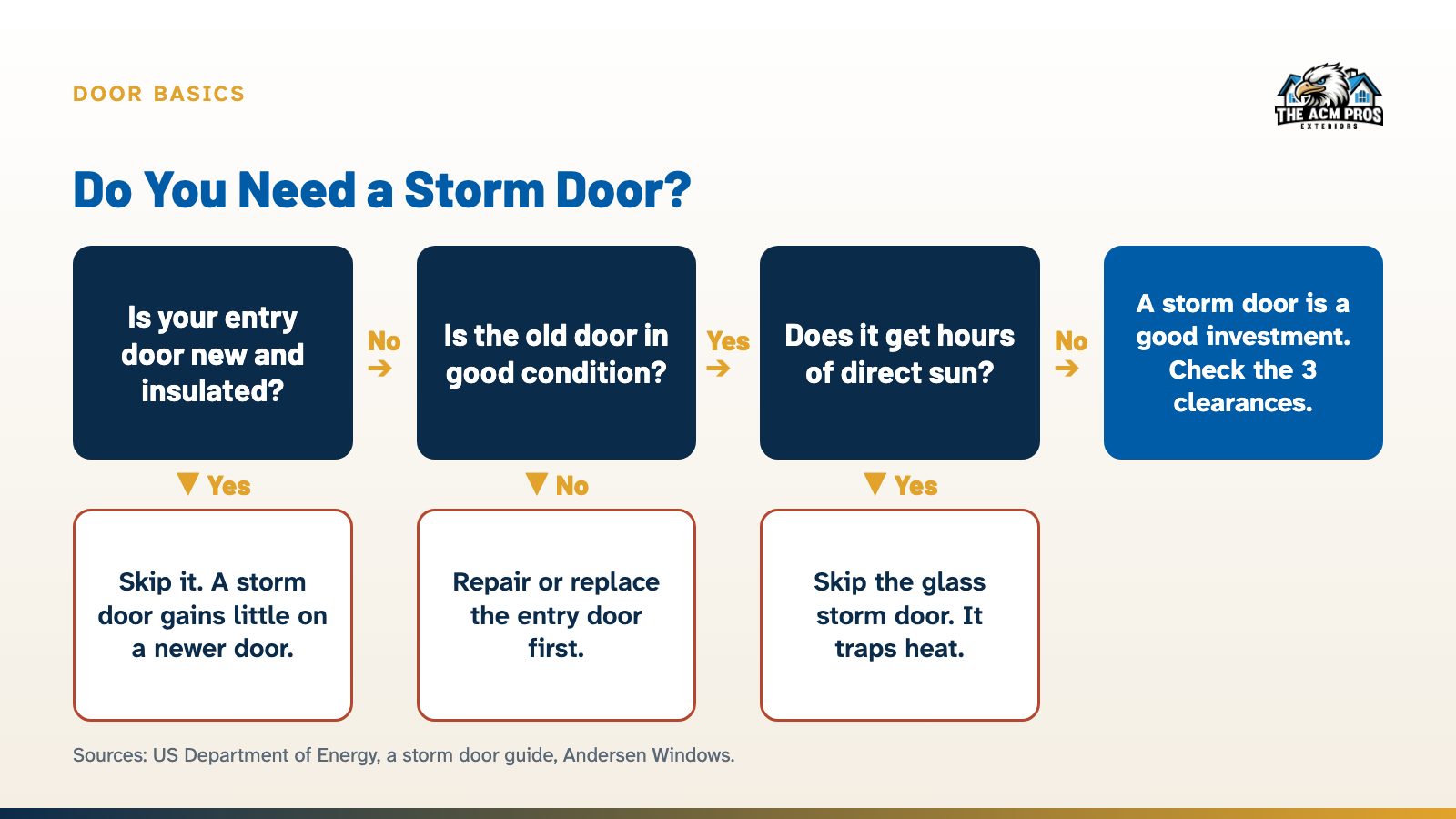
No, you do not need a storm door for your front door when the entry door is new and insulated. The US Department of Energy calls a storm door a good investment for an old door in good condition. The department adds that a storm door on a newer, insulated door is not generally worth the expense.
A storm door guide explains why new homes skip them. A new insulated fiberglass or steel entry door already handles weather and insulation well. A replacement entry door can therefore solve the same problem as a storm door. The decision flow below sorts the choice by door age, condition and sun exposure.
Alternatives deserve a separate answer.
What to Do Instead of a Storm Door?
Instead of a storm door, install a new insulated entry door, refresh the weatherstripping or add a roof over the stoop. A storm door guide says a drafty, sticking or rotted door needs repair, because a storm door only hides the problem. Our team installs each type of entry door that replaces the need for a second door. Fit is the next gate for any storm door.
Can You Put a Storm Door on Any Exterior Door?
No, you cannot put a storm door on any exterior door without checking trim, frame depth and sun exposure. Andersen Windows sets three minimum clearances for its doors. The measuring steps below follow the same order.
- Measure the exterior trim width and confirm at least 3/4 inch of flat trim on each side.
- Measure the trim depth and confirm at least 1 inch for the hinges.
- Measure the door frame depth and confirm at least 2 1/2 inches for the entry door hardware.
- Measure the width in three spots, at the bottom, center and top, and use the smallest number.
- Measure the height from the sill to the top trim.
- Choose the handing, which names the side the hinges go on, as seen from outside.
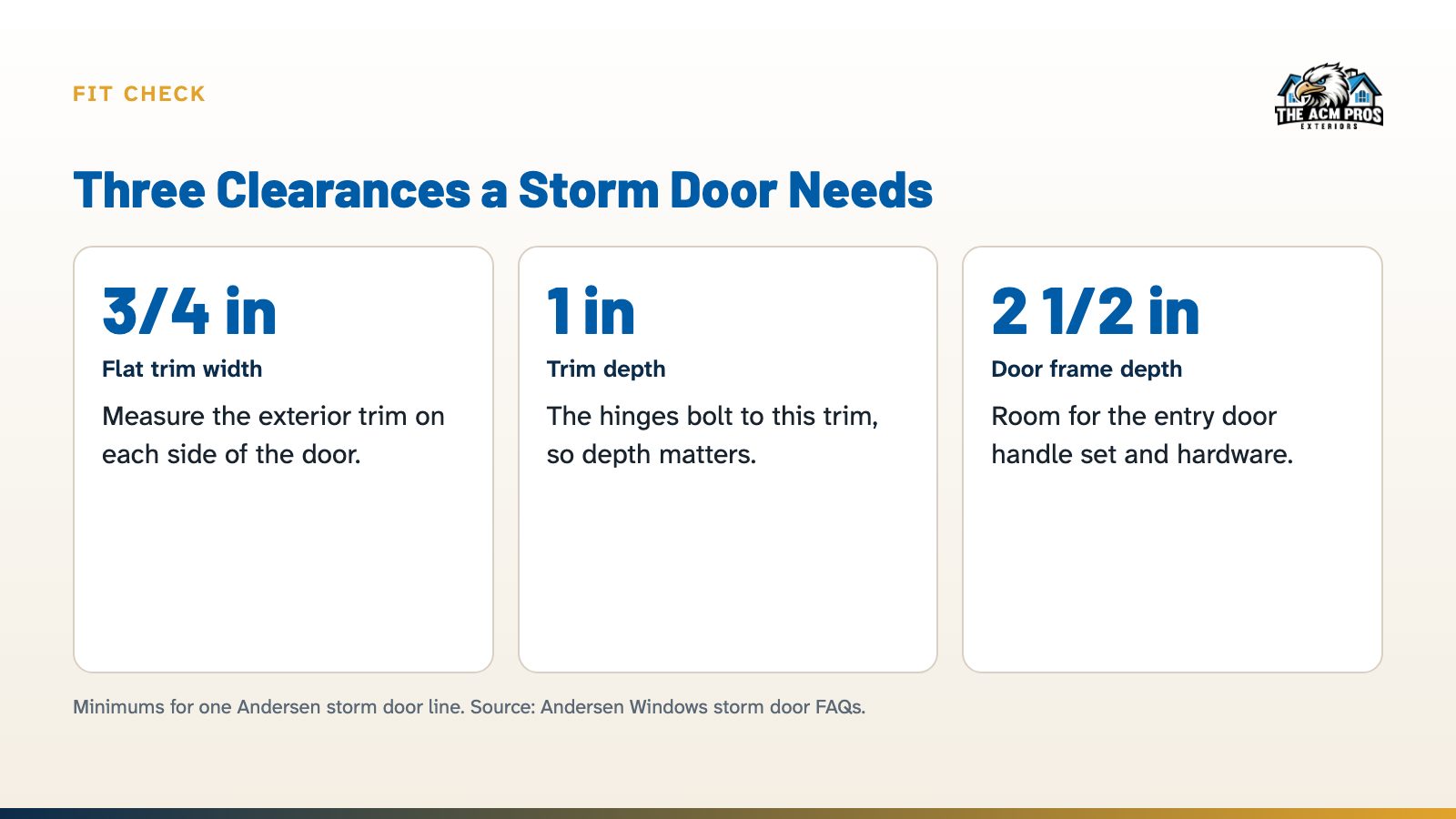
The graphic above shows the three clearance numbers from step one to step three. Odd-size openings may need a custom door, which Andersen Windows also offers. Wider openings follow different rules.
Storm doors for patio doors are hard to find, but they are available, according to the US Department of Energy. A pair of French doors usually calls for a double storm door that joins two panels. Sliding units follow the same fit logic with their own hardware.
Large glass areas collect sun, so homeowners choosing among patio doors should check sun exposure first. Size and handing lead to a common side question.
What Are the Key Storm Door Numbers?
The key storm door numbers are 4 styles, 3 fit clearances and a $154 to $647 door price. The list below gathers the sourced figures from this guide in one place.
- 1878: first known use of the term storm door, according to Merriam-Webster.
- 4: common styles, according to Andersen Windows.
- 3/4 inch: minimum flat trim on each side, according to Andersen Windows.
- 1 inch: minimum trim depth for the hinges, according to Andersen Windows.
- 2 1/2 inches: minimum frame depth for the entry door hardware, according to Andersen Windows.
- $154 to $647: door-only price range, based on Home Depot listings.
- $381: average pro install cost inside a $183 to $604 range, per HomeAdvisor as cited by Homedit.
- Under 1 hour and about 2 hours: install times for the two easiest door lines, according to Andersen Windows.
- 30 days: finishing window for Therma-Tru PVC lite frames, as quoted by a storm door guide.
These figures set the limits for fit, cost and timing. Five myths about storm doors bend those limits, so the next table checks them.
What Are Five Storm Door Myths and Facts?
Five storm door myths fail on the facts, and the sun exposure rule matters most for glass doors. The table pairs each myth with its fact.
Storm Door Myths vs Facts
| Myth | Fact | Source |
|---|---|---|
| Every entry door needs a storm door | A newer insulated door gains little | US Department of Energy |
| Any glass storm door is safe | Glass traps heat after a few hours of direct sun | US Department of Energy |
| A storm door is a screen door | A storm door adds glass and year-round protection | Storm door guide |
| A storm door fits any entry | Fit needs 3/4, 1 and 2 1/2 inch clearances | Andersen Windows |
| Glass decides durability | Closer, sweep, frame and wind chain decide it | Storm door guide |
The table shows that fit, sun and hardware matter more than glass alone. Several side questions follow from those rules.
What Else Should You Know About Storm Doors?
How Much Does a Storm Door Cost?
A storm door costs $154 to $647 for the door alone, based on Home Depot retail listings. Basic mid-view vinyl and wood-core doors sit at the low end. Heavy-duty aluminum doors with retractable screens and dual closers sit at the high end. Installation adds labor on top of the door price. The range chart below sets the door price beside install labor and install time.
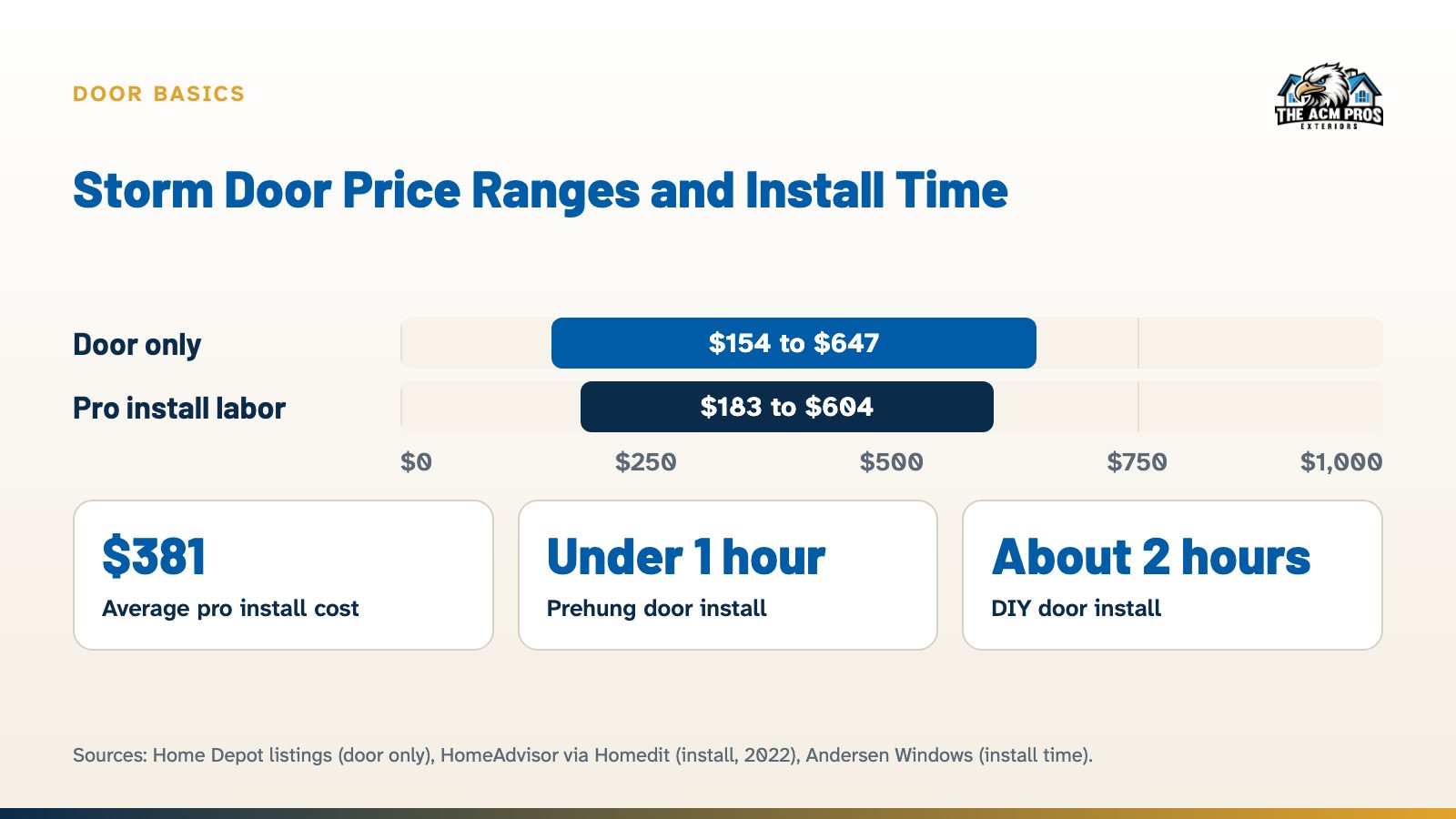
A worked example shows the full spend. A $154 door with a $381 average pro install totals $535, and a $647 door with the same install totals $1,028. Homedit cites HomeAdvisor for the $381 average, which sits inside a $183 to $604 install range from 2022 pricing. These totals are simple sums of the named figures, not a quote.
Storm Door Spend Worked Example
| Line Item | Low-End Door | High-End Door |
|---|---|---|
| Door only | $154 | $647 |
| Average pro install | $381 | $381 |
| Total with pro install | $535 | $1,028 |
| Total as a DIY job (about 2 hours) | $154 | $647 |
The table shows that labor adds the same $381 to either door, so the door choice drives the total. A DIY install removes that labor and takes about 2 hours with the Andersen Windows second DIY line.
What Is the Easiest Storm Door to Install?
The easiest storm door to install is a prehung door, which Andersen Windows estimates at under 1 hour. A second DIY line comes unassembled but cut to length and takes about 2 hours. A pro install line arrives unassembled and must be cut to length. Homeowners who prefer a trained crew can book door installation with us.
What Should You Check Before Buying a Storm Door?
Before buying a storm door, check sun exposure, trim clearances, handing, glass type, hardware and the condition of the entry door. Each item comes from the sources above, and each can rule a door in or out.
- Sun exposure: avoid glass when the entry door gets more than a few hours of direct sun daily.
- Trim clearances: 3/4 inch flat trim, 1 inch trim depth and 2 1/2 inches of frame depth.
- Handing: the hinge side seen from outside, matched to the entry door.
- Glass type: Low-E glass for a sun-facing entry, and laminated glass for impact resistance.
- Hardware: two closers, a flexible sweep, a wind chain and well-joined corners.
- Entry door condition: a drafty or rotted door needs repair first.
What Are the Red Flags on a Cheap Storm Door?
Red flags on a cheap storm door include a single closer, no wind chain, thin frame walls and a stiff sweep. A storm door guide says hardware, not glass, decides how long a storm door lasts. A door that is missing a wind chain can have bent hinges after one gust. A sweep that goes hard stops sealing after a few seasons.
Should a Storm Door Open the Same Way as a Front Door?
A storm door should open from the same hinge side as the front door. Andersen Windows says a front door that opens from the right usually pairs with a storm door that opens from the right. The storm door swings outward while the front door swings inward. Handing is judged from outside the house.
What Is the Difference Between a Storm Door and a Double Storm Door?
A storm door uses one panel for a standard doorway, while a double storm door joins two panels for wide openings. Double entry doors and French doors are the usual homes for a double unit. The two leaves meet in the middle. A single unit has one swinging leaf.
Which Is Better, an Aluminum or Vinyl Storm Door?
An aluminum storm door and a vinyl storm door both resist corrosion, so the choice comes down to build and finish. Aluminum is light, while vinyl needs no painting and can mimic wood grain. Storm door guides add that vinyl doors often hide an internal steel frame for strength. Thicker walls and well-joined corners matter more than the material name.
Do All Exterior Doors Need a Storm Door?
No, not all exterior doors need a storm door, because insulated fiberglass and steel doors handle weather well alone. The US Department of Energy ties the decision to the age and condition of the existing door.
Do People Not Use Storm Doors Anymore?
People still use storm doors, mainly as retrofits on older entry doors and exposed doorsteps. A storm door guide says new installs are largely retrofits rather than standard features on new builds. New homes skip them because builders control cost and buyers like a single clean door.
Frequently Asked Questions
What's a Storm Door Made Of?
A storm door is made of an aluminum, vinyl, fiberglass, steel or wood frame holding glass and a screen. The frame material sets the strength and upkeep. The materials table above compares the four main choices.
What Is the Storm Door Closer?
The storm door closer is the pneumatic cylinder that pulls the door shut and keeps it from slamming. A storm door guide says the closer is the most-used part and the first to wear out on a cheap door. Two closers, mounted top and bottom, hold the door square.
What Is the Best Storm Door With a Retractable Screen and Glass?
A strong pick is a full-view retractable storm door with a thick aluminum frame, two closers and Low-E glass. A quality sweep and a wind chain also protect the hinges. Andersen Windows and the US Department of Energy both point to hardware and glass quality as the deciding factors.
How Can The ACM Pros Help With Storm Door Installation?
The ACM Pros helps by measuring the entry, checking the trim and installing the storm door that fits it. The answer to what is a storm door is simple on paper, and a site visit confirms the fit. We handle door installation for entry, French, patio and storm doors.
Each job starts with a free written estimate. The crew measures the opening before ordering any door. That visit confirms trim depth, handing and sun exposure for the entry.
Our family business, ACM Pros Exteriors, is based in Madison, Alabama, and run by Brad and Chase Miller since 2019. We are licensed in Alabama and insured for residential and commercial work, and we serve North Alabama and Middle Tennessee.
Finished exterior work shows how new doors sit beside siding and trim. Homeowners can browse door projects for examples. Photos help compare frame colors, glass styles and handle sets before the first visit.
Storm doors are one of the products in that mix, and we fit storm doors in each style covered above. The styles run from full-view interchangeable to half light, and each one gets checked against the three trim clearances before work starts. The estimate visit covers the sun exposure of the entry as well.
Call us at (256) 585-6817 to price a storm door for your entry.