What Are the Types of Vinyl Siding?
The types of vinyl siding are 4 main profiles: horizontal lap, vertical, board and batten, and shake and shingle.
By the ACM Pros team, Madison, AlabamaPublished 13 minute read
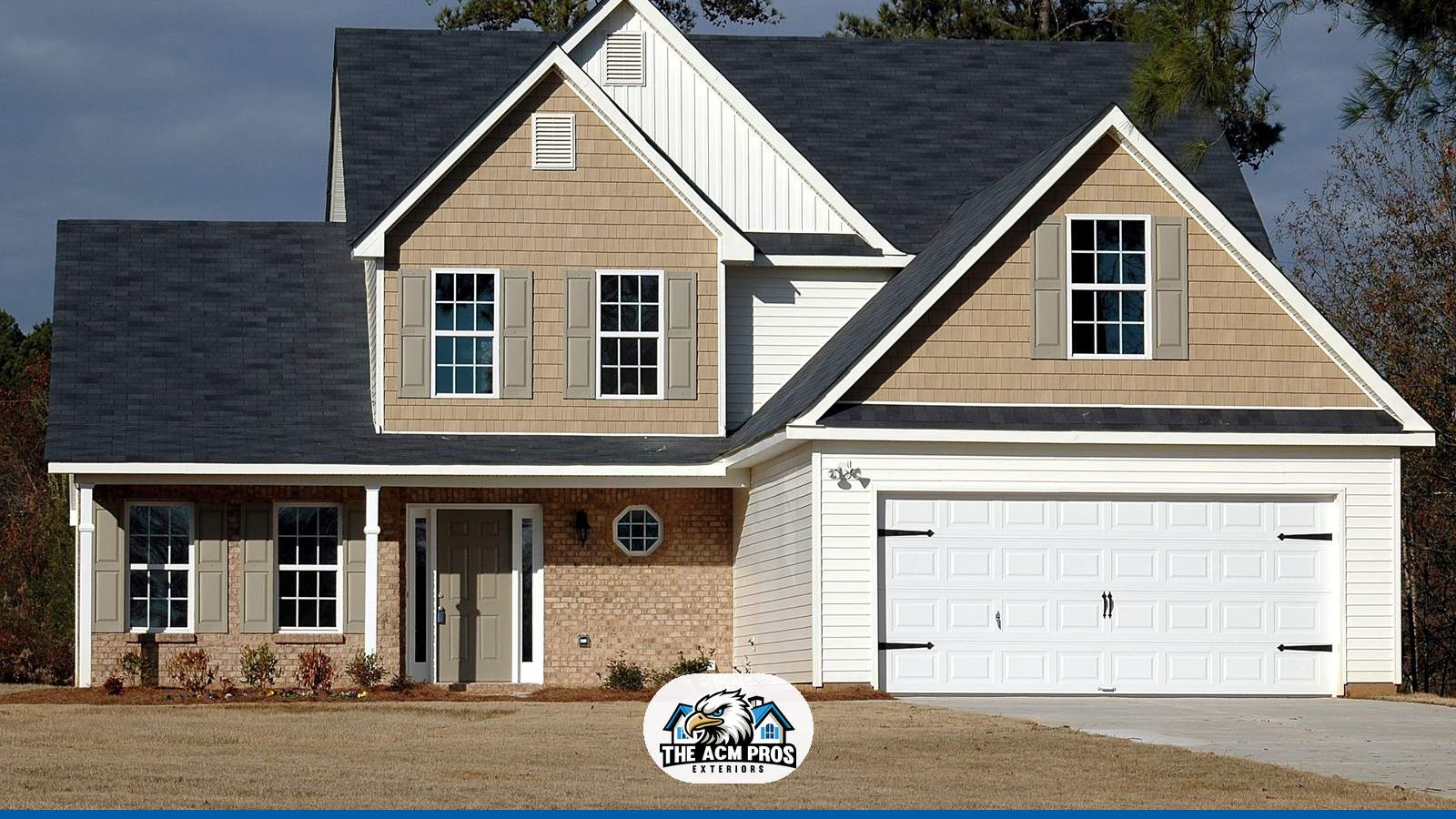
The types of vinyl siding are 4 main profiles: horizontal lap, vertical, board and batten, and shake and shingle. Each profile also comes in 3 thickness grades, from 0.040 to 0.046 inches, plus an insulated version with foam backing. Installed vinyl siding costs $3 to $12 per square foot, depending on the type. Profile, grade, and backing decide how a house looks, wears, and performs.
Key Takeaways
- Horizontal lap, vertical, board and batten, and shake and shingle are the 4 main vinyl siding profiles.
- Builder grade is 0.040 inches thick, standard is 0.042 inches, and premium is 0.046 inches.
- Insulated vinyl siding bonds rigid foam to the panel and is labeled R-2 to R-5.
- Installed cost runs from $2 to $12 per square foot, and plain clapboard costs the least.
- Vinyl panels need loose fastening because they expand and contract with temperature.
What Are the Types of Vinyl Siding for Houses?
Types of vinyl siding for houses fall into 4 main profiles: horizontal lap, vertical, board and batten, and shake and shingle. Makers add scalloped, brick-look, and log-look panels as accents. The Polymeric Exteriors Product Association (PEPA) reports more than 400 vinyl siding styles and colors.
Every profile can be ordered in different grades and with or without foam backing. We install these panels on homes through our vinyl siding replacement work. The table below compares the main kinds of vinyl siding by look, use, and installed cost.
Types of Vinyl Siding by Profile, With Installed Cost per Square Foot (Fixr)
| Profile | Look | Common Use | Cost per Sq Ft |
|---|---|---|---|
| Clapboard | Flat horizontal boards, 4 inch lap | Whole house | $2 to $6 |
| Dutch lap | Beveled top edge, deep shadow line | Whole house | $3 to $7 |
| Beaded | Rounded bead on the bottom edge | Whole house | $2 to $7 |
| Vertical | Panels running up and down | Accent walls | $3 to $8 |
| Board and batten | Wide boards with narrow raised strips | Gables, whole house | $3 to $9 |
| Shake | Molded cedar shake texture | Gables, dormers | $3 to $10 |
| Scalloped | Rounded fish scale shingles | Gables, Victorian homes | $4 to $9 |
| Insulated | Any profile with foam backing | Whole house | $5 to $12 |
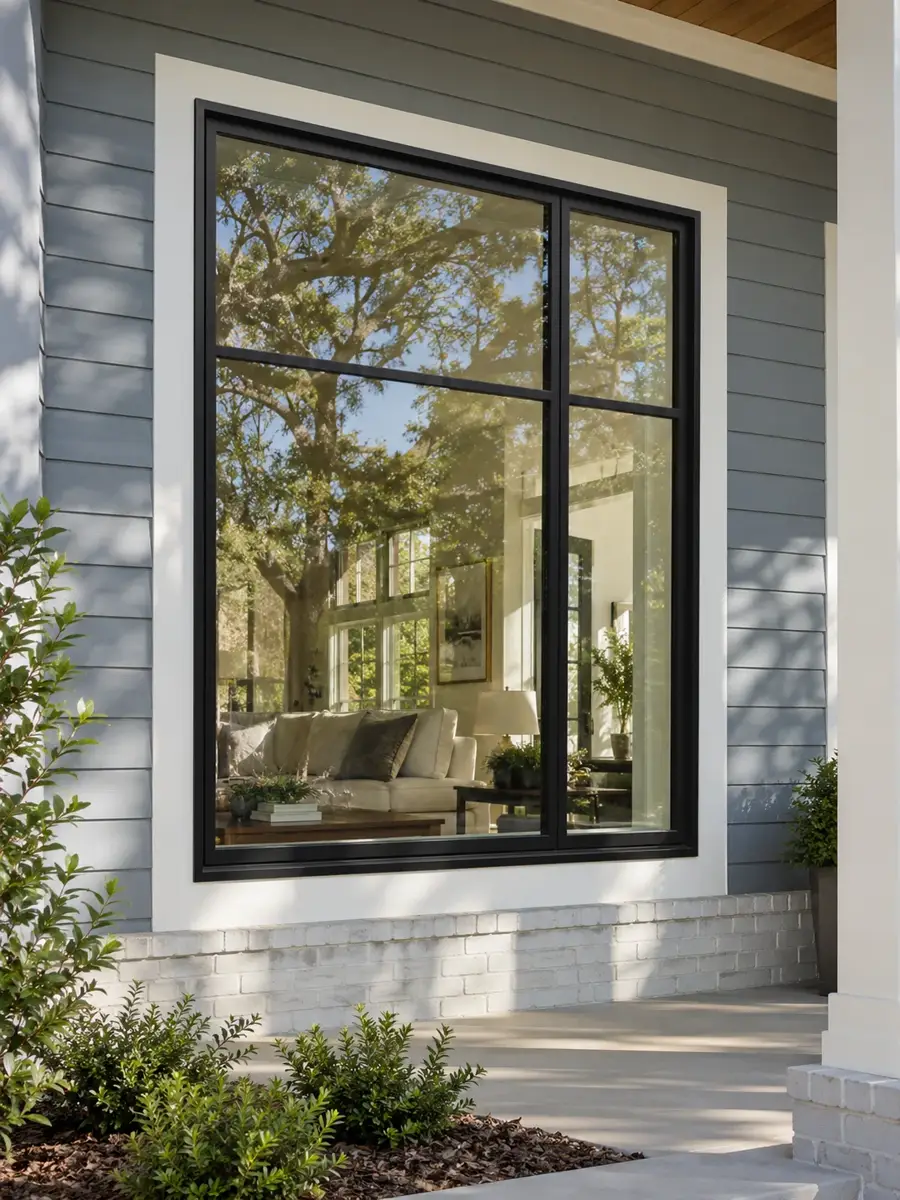
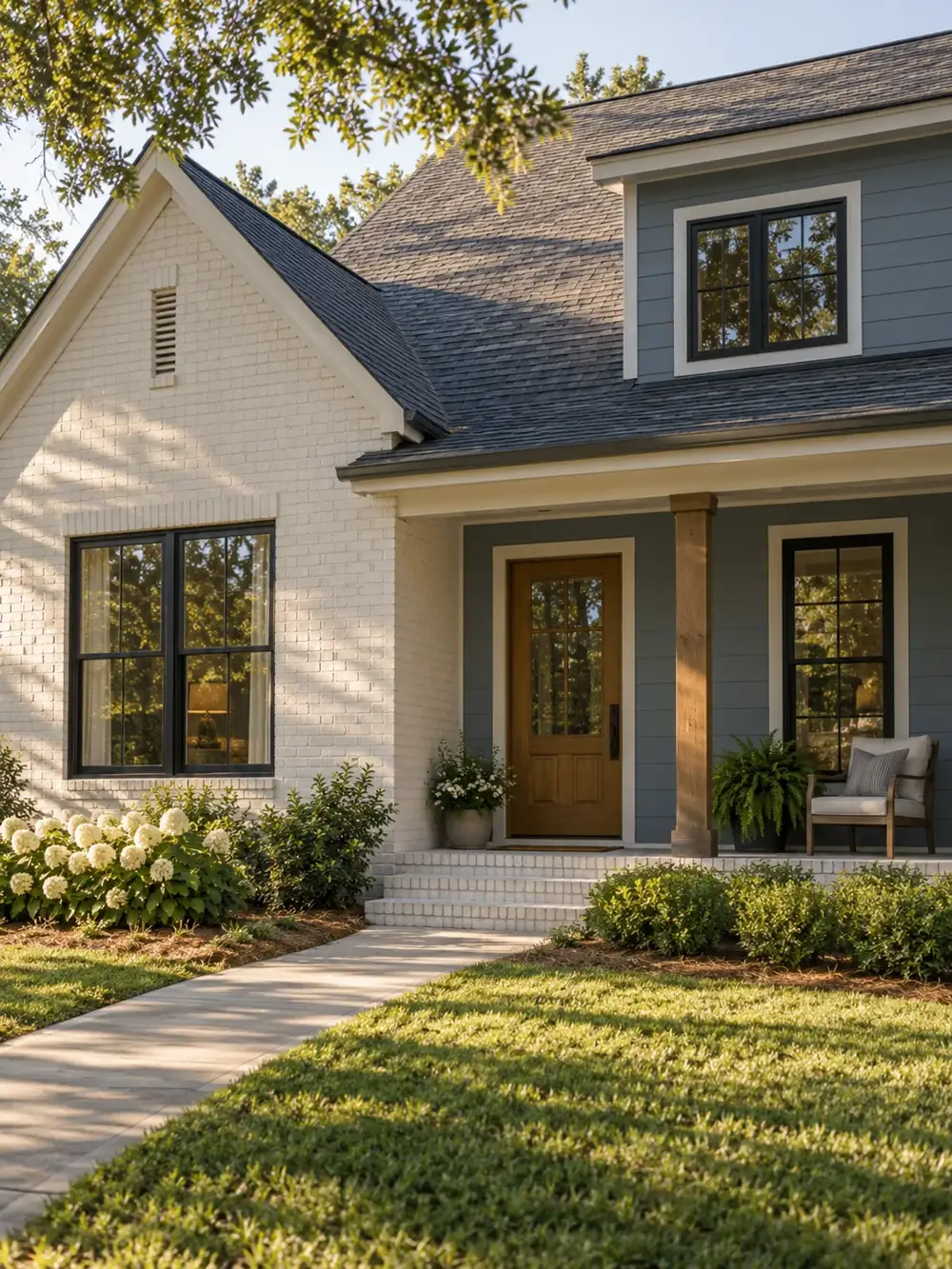
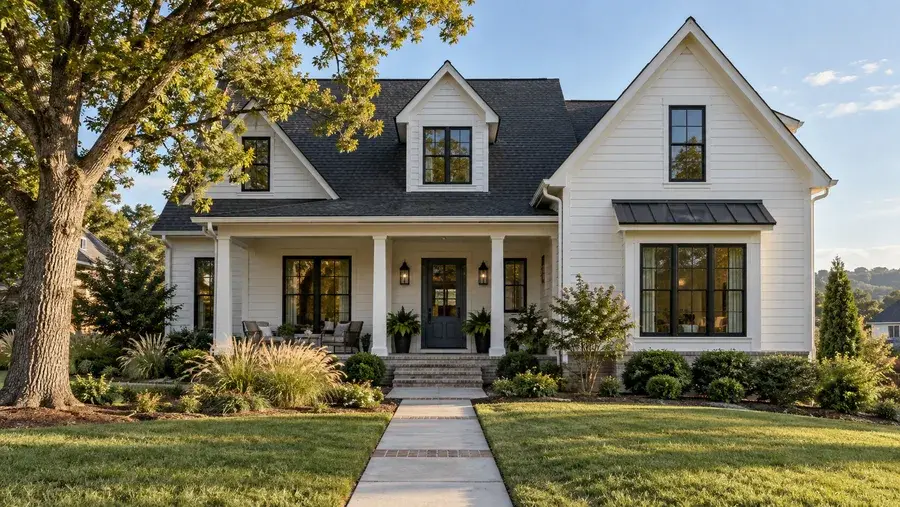
Clapboard is the lowest-cost profile in that table, and insulated panels carry the highest range. The first image below shows the four main profiles side by side.
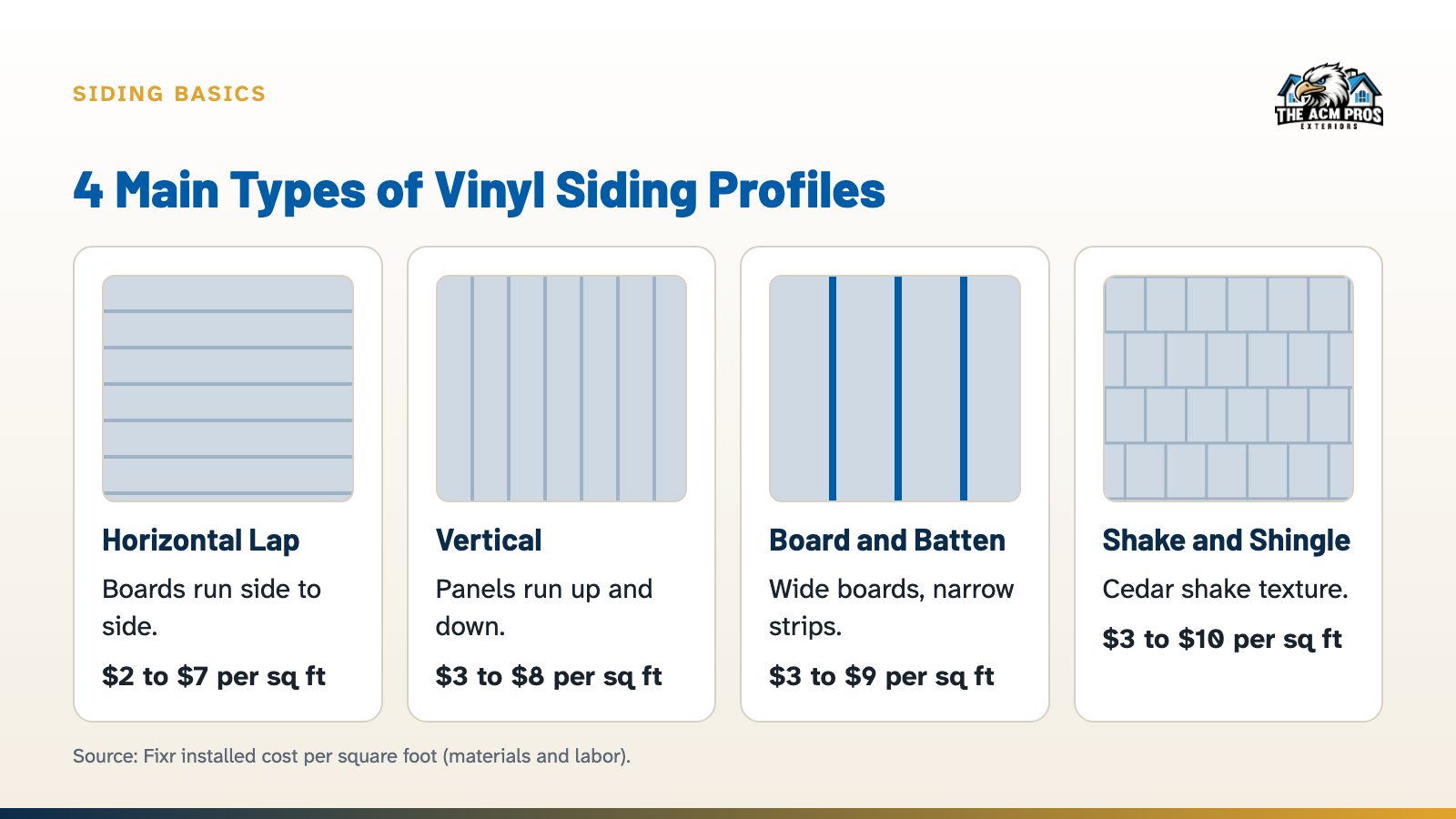
Horizontal lap is the first profile to understand, because the table above shows it as the whole-house choice.
What Are the Horizontal Vinyl Siding Types?
Horizontal vinyl siding types include clapboard, traditional lap, Dutch lap, beaded, and smooth panels. All five run side to side and overlap from bottom to top. The overlap sheds water down the wall and away from the sheathing.
What Is Clapboard Vinyl Siding?
Clapboard vinyl siding is the plain horizontal board profile with a 4 inch lap. Traditional lap siding looks similar but uses wider 6 to 7 inch planks, according to a siding style guide. Both profiles copy painted wood boards.
Clapboard is the least expensive profile, at $2 to $6 per square foot installed. Dutch lap adds a different edge, covered next.
What Is Dutch Lap Vinyl Siding?
Dutch lap vinyl siding is a horizontal panel with a beveled or grooved top edge. The bevel casts a deeper shadow line than clapboard. A siding style guide says the style was designed to look hand-carved.
Dutch lap installs at $3 to $7 per square foot. Beaded and smooth panels give two quieter options.
What Are Beaded and Smooth Vinyl Siding?
Beaded vinyl siding is a horizontal panel with a rounded bead along the bottom edge. Smooth vinyl siding has no wood grain and shows a flat, modern face. Beaded siding costs $2 to $7 per square foot and smooth siding costs $2 to $6.
Horizontal panels are one direction, and vertical panels are the other.
Is Vertical or Horizontal Vinyl Siding Better?
Vertical and horizontal vinyl siding both perform well, so the better choice is the one that fits the wall. Horizontal panels suit whole houses and cost less. Vertical panels suit gables, entries, and accent walls.
The PEPA installation guidance sets one real difference between the two. Installers fasten horizontal panels every 16 inches at most and vertical panels every 12 inches. Vertical siding also starts in back-to-back J-channels instead of a starter strip.
Vertical vinyl siding costs $3 to $8 per square foot installed. Board and batten is the well-known vertical style.
What Is Board and Batten Vinyl Siding?
Board and batten vinyl siding is a vertical profile with wide flat boards and narrow raised strips over the seams. The panel molds the battens in, so installers hang one piece instead of many. The look comes from barns and now suits modern farmhouse exteriors.
Board and batten costs $3 to $9 per square foot. Many homes pair it with shake panels on the gable.
What Are Shake, Shingle, and Scalloped Vinyl Siding Types?
Shake, shingle, and scalloped vinyl siding are textured panels that imitate cedar shakes, cut shingles, and fish scales. Installers use them as accents on gables, dormers, and bump-outs. Some homes use them on every wall.
Shake panels come as straight-edge rows or as hand-split rows with uneven bottoms. A siding style guide describes the hand-split style as the closest match to real cedar. Shake panels cost $3 to $10 per square foot installed.
Scalloped panels form half-round shingles and cost $4 to $9 per square foot. Brick-look and stone-look panels cost $4 to $10 and $4 to $11, and log-look panels cost $3 to $8. Profile is one decision, and thickness grade is the next.
What Are the Different Grades of Vinyl Siding?
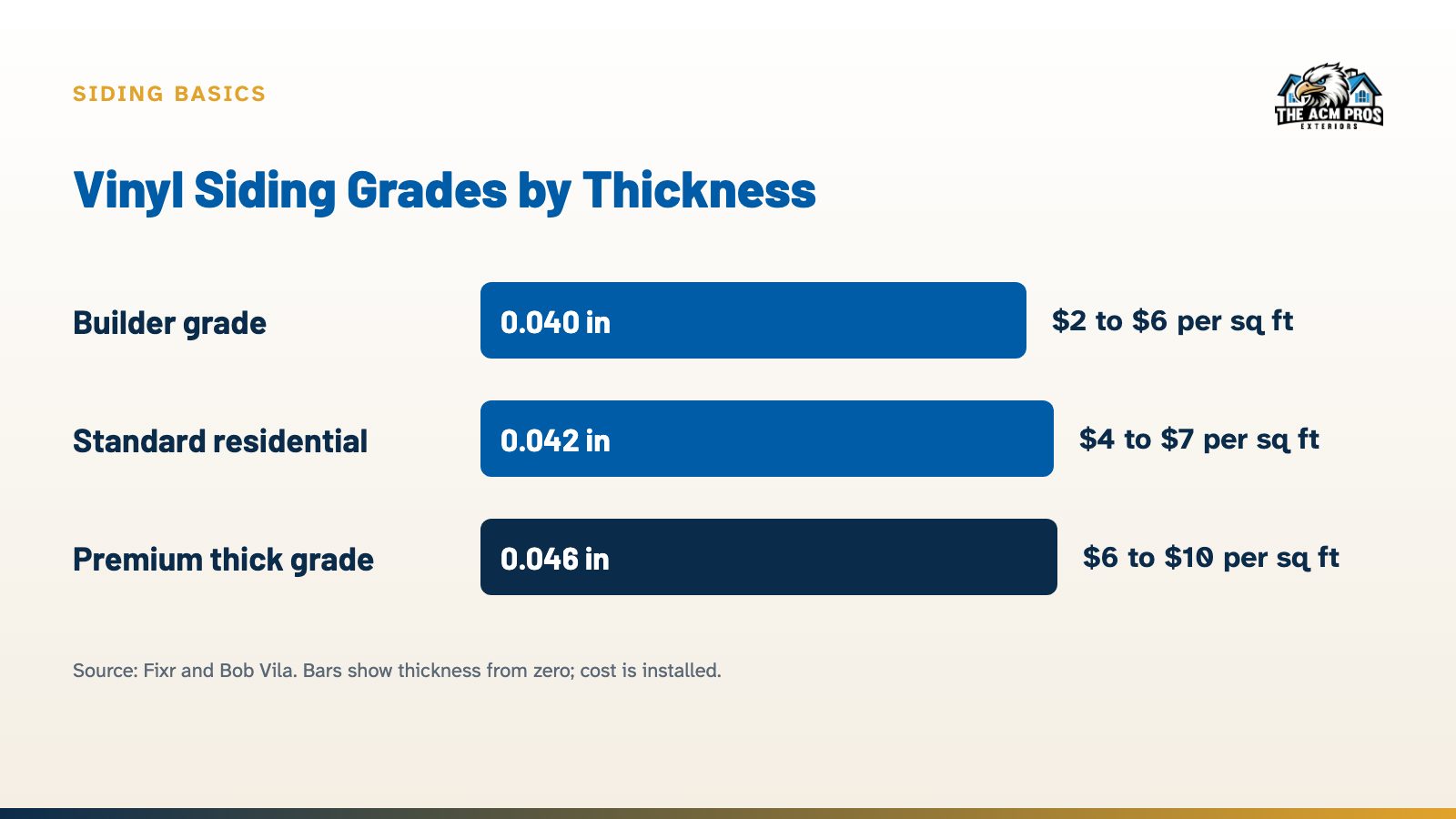
Vinyl siding comes in 3 grades by thickness: builder at 0.040 inches, standard at 0.042 inches, and premium at 0.046 inches. Thicker panels resist warping and impact better. They also cost more per square foot.
The table compares the three grades using Fixr and Bob Vila thickness figures. Fixr prices each grade as an installed range.
Vinyl Siding Grades by Thickness and Installed Cost per Square Foot (Fixr)
| Grade | Thickness | Cost per Sq Ft |
|---|---|---|
| Builder grade | 0.040 inches | $2 to $6 |
| Standard residential | 0.042 inches | $4 to $7 |
| Premium thick grade | 0.046 inches | $6 to $10 |
Premium grade costs about twice as much as builder grade, according to Fixr. The graphic below shows the same three grades as bars.
What Thickness of Vinyl Siding Is Best?
Premium 0.046 inch vinyl siding is the thickest standard grade and resists warping and impact better than thinner panels. Builder grade at 0.040 inches serves projects where cost leads. Standard 0.042 inch siding sits between the two.
Thickness is not the only quality marker for each type of vinyl siding. Rolled-over nail hems and foam backing also stiffen a panel. Backing leads to the next type.
What Is Insulated Vinyl Siding and Does It Make a Difference?
Insulated vinyl siding is a vinyl panel with rigid foam permanently attached to the back, and it adds modest wall insulation. Panels are labeled R-2 to R-5, and field studies measured a gain of R-2 to R-2.7, according to Siding Authority. The foam also stiffens the panel.
Siding Authority notes that insulated panels are about 40% longer, so a wall has fewer seams. Insulated siding reached the market in 1997. Installed cost runs $5 to $12 per square foot.
PEPA separates insulated vinyl from backed vinyl. Backed vinyl has foam too, but it does not reach the R-value required to count as insulated. Polypropylene siding is a fourth cladding made by injection molding.
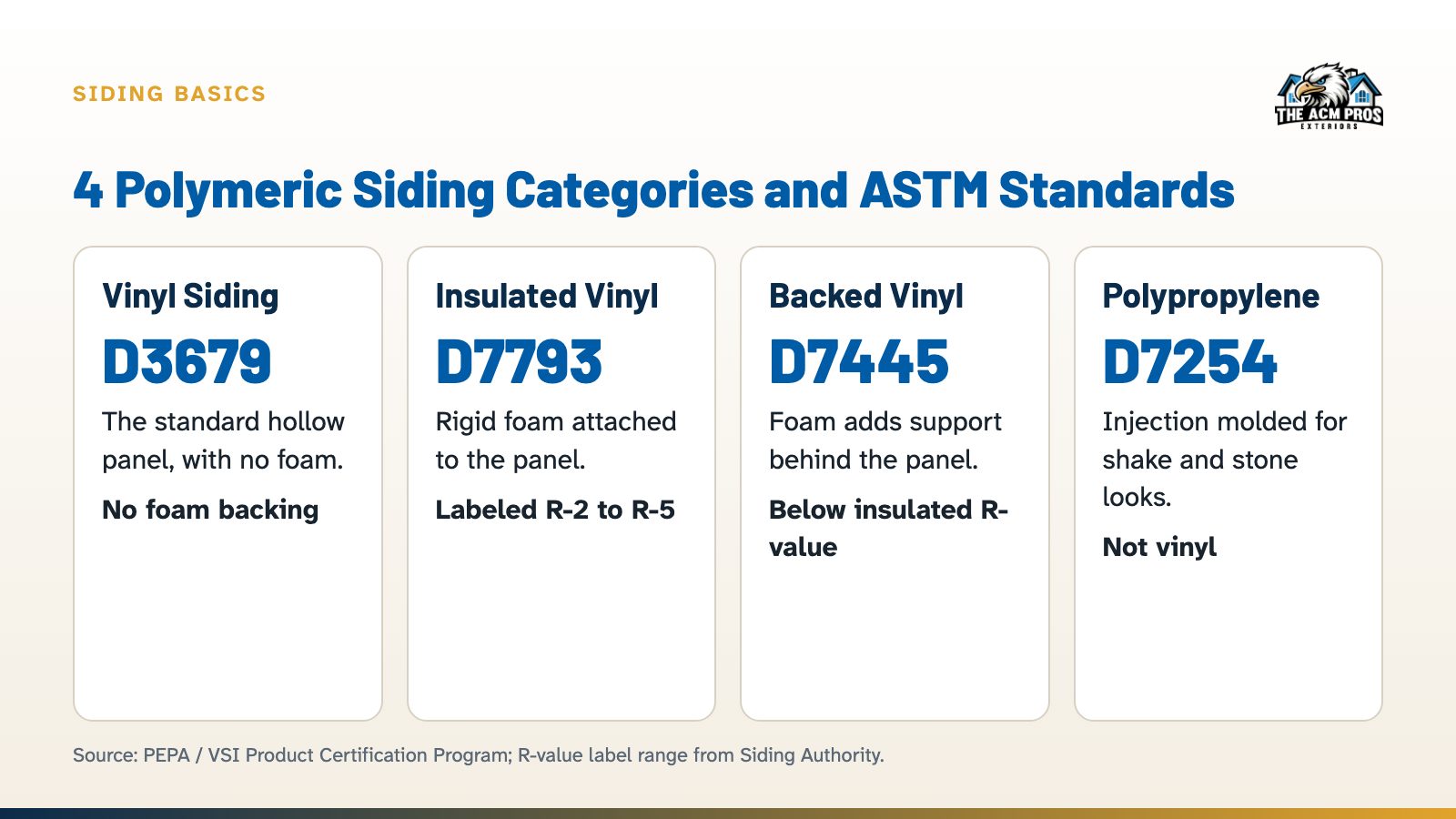
The graphic lists the ASTM standard for each category, and each standard sets its own tests. Cost comes next.
How Much Do the Types of Vinyl Siding Cost?
Vinyl siding costs $3 to $12 per square foot installed, and the national average is $12,000 per project. Fixr puts whole-house projects between $6,000 and $24,000. Labor covers 30% to 50% of the total. The chart below shows the installed range for each type.
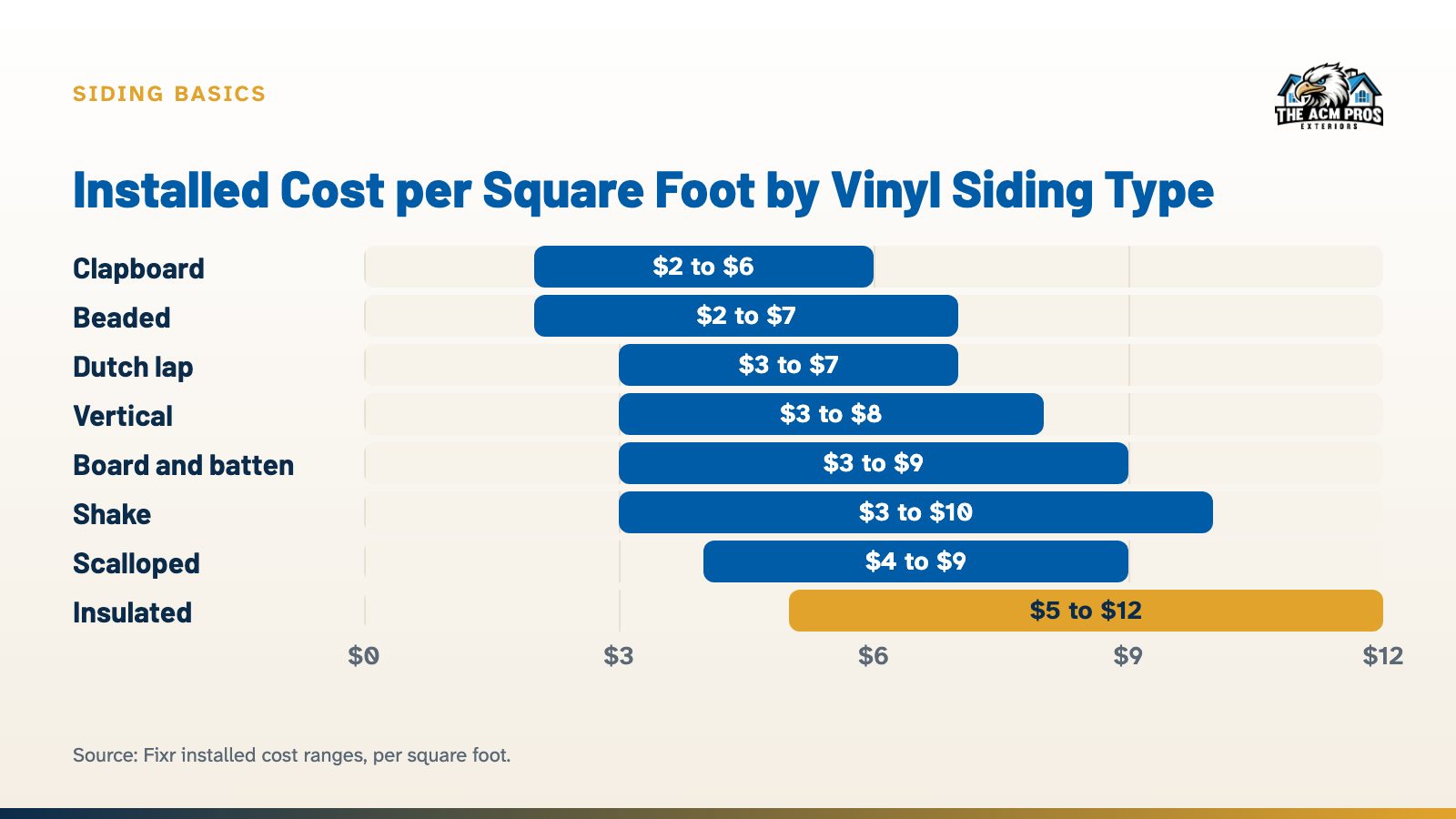
A 2,000 square foot house falls in that same $6,000 to $24,000 range across all types. Simple clapboard sits at the low end and insulated or decorative panels at the high end. A written estimate from a vinyl siding installation crew fixes the exact figure for one house.
Vinyl costs less than the other claddings in the Fixr comparison. Fiber cement runs $5 to $17 per square foot, stucco $7 to $17, and brick $8 to $21. House size changes the total next.
How Much Does Vinyl Siding Cost for Each House Size?
Vinyl siding costs $3,000 to $12,000 for 1,000 square feet of wall and $9,000 to $36,000 for 3,000 square feet. Fixr counts one square as 100 square feet of siding. The table lists six wall sizes at the $3 to $12 per square foot range.
Vinyl Siding Cost by Exterior Square Footage (Fixr)
| Exterior Square Feet | Total Installed Cost |
|---|---|
| 1,000 | $3,000 to $12,000 |
| 1,500 | $4,500 to $18,000 |
| 1,800 | $5,400 to $21,600 |
| 2,000 | $6,000 to $24,000 |
| 2,500 | $7,500 to $30,000 |
| 3,000 | $9,000 to $36,000 |
The grade chosen moves a 2,000 square foot job inside that range. Fixr totals $4,000 to $12,000 for builder grade and $8,000 to $14,000 for standard grade. Premium grade totals $12,000 to $20,000, and insulated super thick grade totals $14,000 to $24,000.
Lifetime cost follows from those totals. A $12,000 average project over a 20 to 40 year life works out to $300 to $600 per year. Fixr gives the 20 to 40 year life, and the next section covers the numbers behind it.
What Are the Key Numbers for Vinyl Siding Types?
The key numbers for vinyl siding types are 9 figures that cover grade, cost, movement, fastening, and service life. Each figure comes from a named source.
- 0.040 to 0.046 inches is the thickness range of builder, standard, and premium grades (Fixr and Bob Vila).
- $3 to $12 per square foot is the installed cost range, with a $12,000 national average (Fixr).
- $11,451 is the national average project cost in the Bob Vila data.
- $2.15 to $5.25 per square foot is the labor range, with a $3.70 average (Bob Vila).
- 1/2 inch or more is how far a 12 foot 6 inch panel expands and contracts (PEPA).
- 1/32 inch is the clearance left under each nail head (PEPA).
- 16 inches and 12 inches are the maximum nail spacing for horizontal and vertical panels (PEPA).
- R-2 to R-2.7 is the measured gain from insulated panels, against an R-2 to R-5 label (Siding Authority).
- 67.2 percent is the share of cost that owners recoup after installing vinyl siding (Bob Vila).
Removing old siding adds $400 to $600, according to Bob Vila. That cost sits outside the panel price, so a quote needs to list it. Choosing the right type comes next.
What Type of Vinyl Siding Is the Best?
No single type of vinyl siding suits every house, since the right type depends on wall, impact risk, and budget. Profile sets the look, grade sets the stiffness, and backing sets the insulation. Fixr says thicker vinyl stands up better to impact and blown debris.
The table matches six common situations to a profile, a grade, and a backing choice. Each row follows the facts in the sections above.
Vinyl Siding Type by Situation: Profile, Grade, and Backing
| Situation | Profile | Grade | Backing |
|---|---|---|---|
| Whole house on a budget | Clapboard or beaded | 0.040 inches | Hollow |
| Whole house with deeper shadow lines | Dutch lap | 0.042 inches | Hollow |
| Gables, entries, and dormers | Vertical, board and batten, or shake | 0.042 inches | Hollow |
| Walls hit by blown debris or yard tools | Horizontal lap | 0.046 inches | Insulated |
| Older home with drafty walls | Any profile | 0.042 to 0.046 inches | Insulated, R-2 to R-5 |
| Victorian or historic look | Scalloped accents on lap | 0.042 inches | Hollow |
The three-step graphic below turns the table into one decision path. Pick the location, then the grade, then the backing.
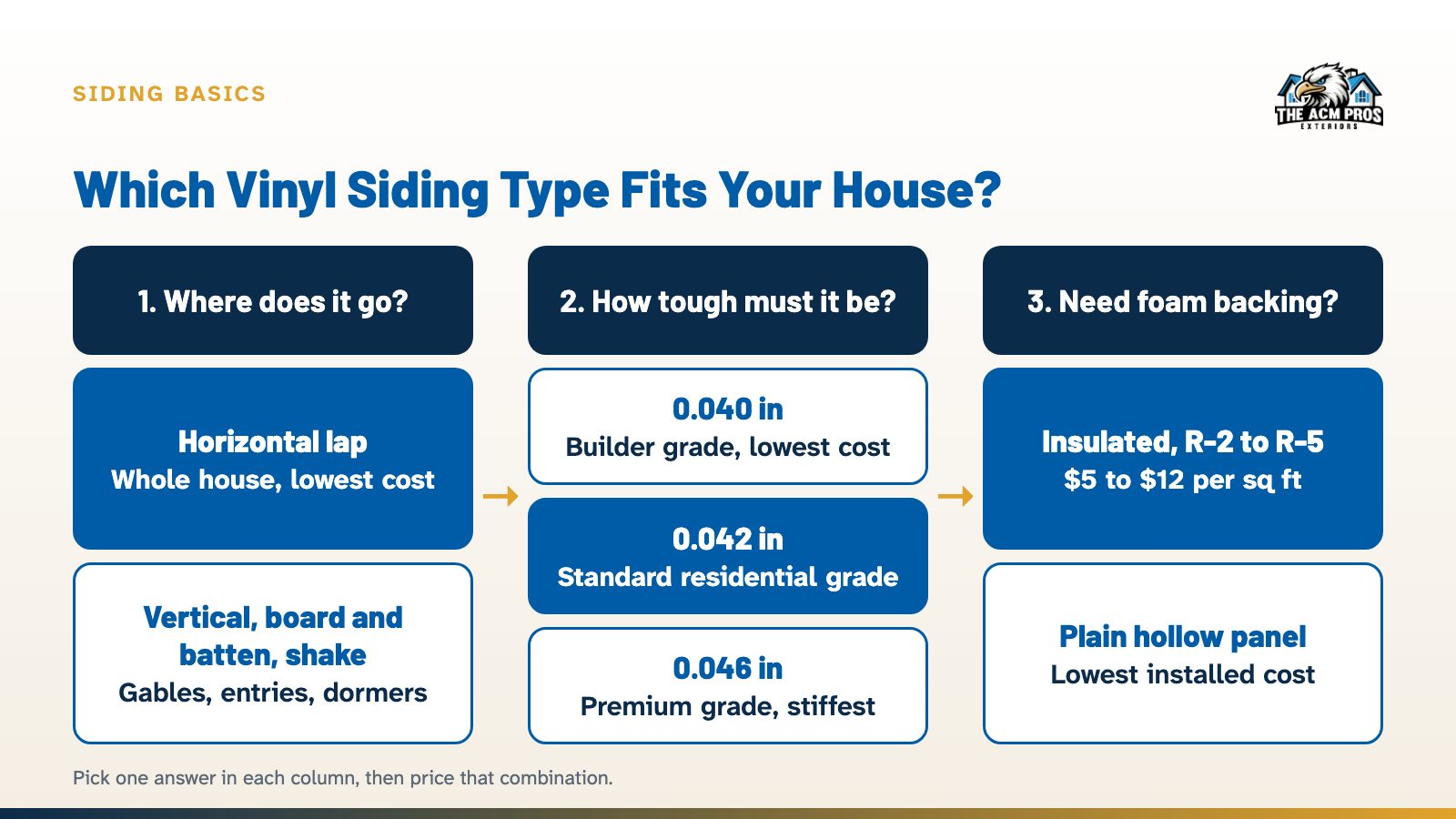
A chosen type still needs correct fastening, and fastening decides how the panels perform.
How Do Installers Fasten Vinyl Siding?
Installers fasten all types of vinyl siding for homes with nails driven loosely in the center of each slot. The loose fit lets panels move. PEPA puts expansion at 1/2 inch or more over a 12 foot 6 inch panel. Tight nails cause buckling.
The PEPA installation guidance gives the core rules. Fasteners need about 1/32 inch of clearance under the head, about the thickness of a dime. They also need to reach at least 1 1/4 inches into nailable material.
- Apply a water-resistive barrier such as house wrap or felt paper over the sheathing.
- Flash windows, doors, corners, and wall-to-roof joints with metal flashing.
- Snap a level chalk line and set the starter strip or J-channel.
- Nail through the center of each slot, 16 inches apart at most for horizontal panels.
- Leave 1/4 inch of clearance at openings, and 3/8 inch below 40 degrees Fahrenheit.
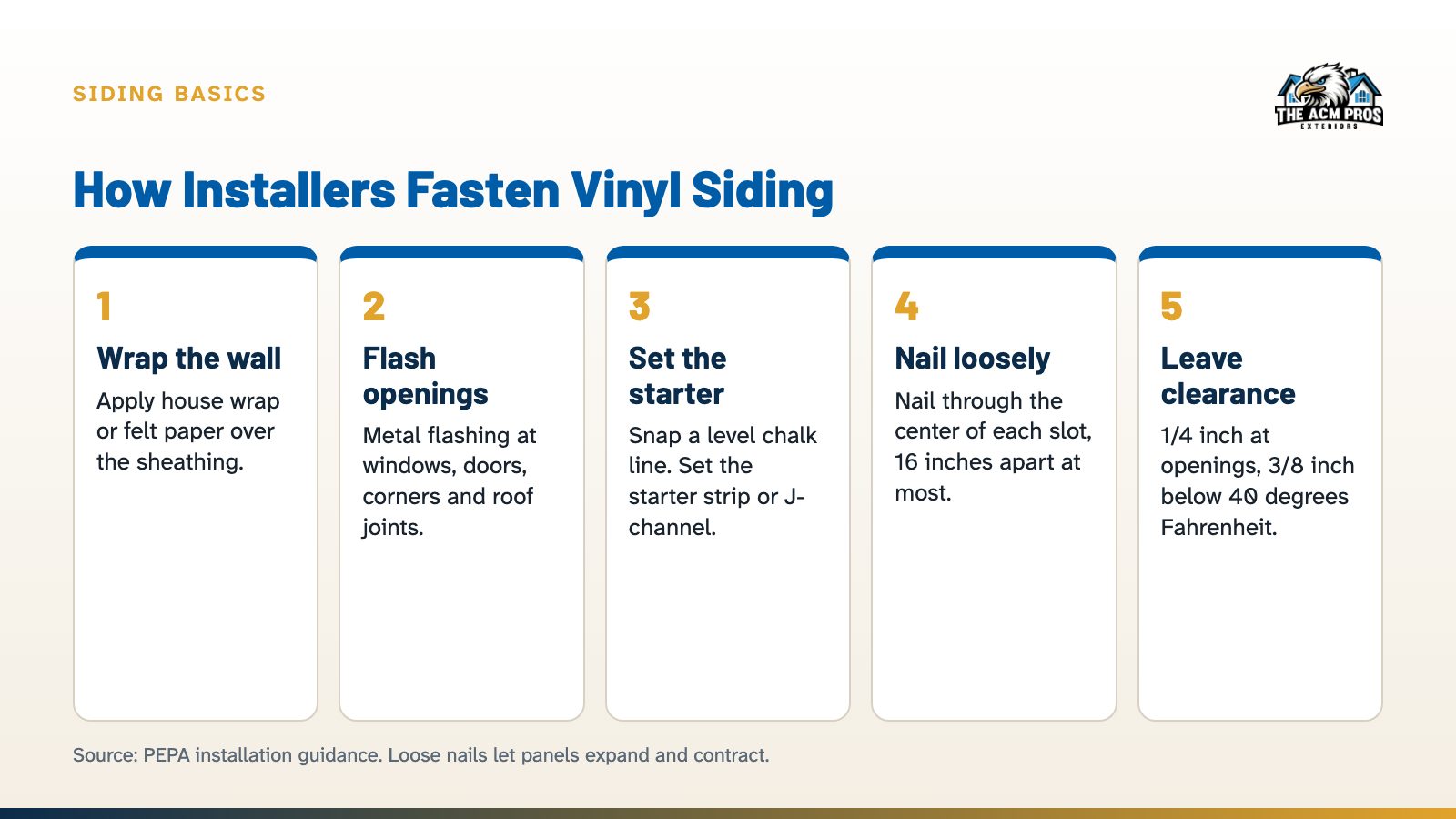
The five steps above show the install order. Trim pieces and accessories complete the wall and take a nail every 8 to 12 inches. Several side questions come up before a homeowner picks a type.
What Else Should You Know Before Choosing Vinyl Siding?
Should Vinyl Siding Be Nailed or Screwed?
Vinyl siding should be nailed, though PEPA also allows screws and staples. Nails need 5/16 inch heads and 1 1/2 inch length for general use. Screws must be #8 corrosion-resistant self-tapping fasteners.
How Far Apart Should Vinyl Siding Be Nailed?
Vinyl siding should be nailed no more than 16 inches apart on horizontal panels and 12 inches apart on vertical panels. Accessories take a nail every 8 to 12 inches.
Is 4 Inch or 5 Inch Siding Better?
Four inch and 5 inch vinyl siding perform the same, and the number names how much of each board shows. Double 4 shows two 4 inch rows per panel. Double 5 shows two 5 inch rows and covers a wall with fewer courses.
What Colors Does Vinyl Siding Come In?
Vinyl siding comes in hundreds of factory colors, since PEPA counts more than 400 styles and colors together. The color is part of the panel, so it needs no paint. Homeowners can compare finished walls in our siding project photos before choosing a color.
Does Vinyl Siding Come in 4X8 Sheets?
Vinyl siding does not come in 4X8 sheets, because standard panels run about 12 to 12.5 feet long. Panels of 16 feet or more reduce seams on wide walls. Shake panels come in sheets of several rows.
What Should You Put Under Vinyl Siding?
Under vinyl siding, put a water-resistive barrier such as house wrap or felt paper over the wall sheathing. Flashing then seals windows, doors, and corners. Insulated panels bring their own foam backing.
What Is the Downside of Vinyl Siding?
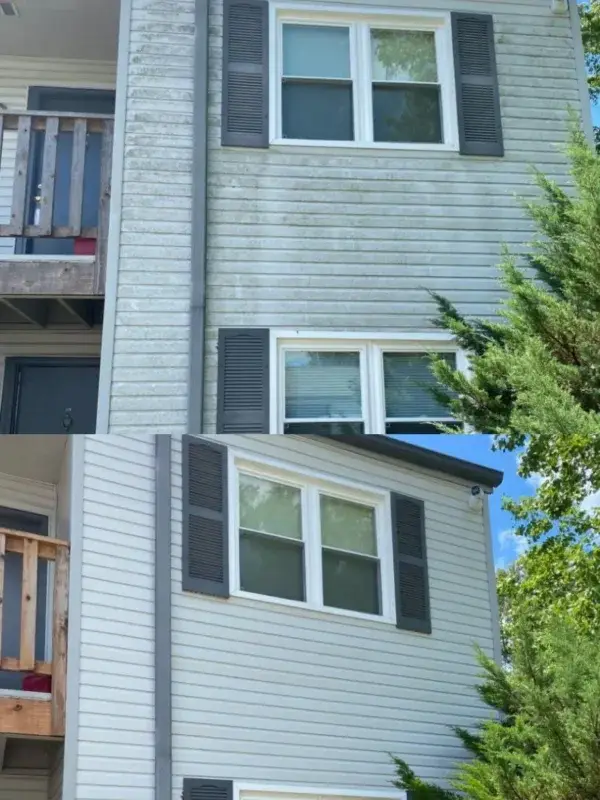
The main downside of vinyl siding is movement, since panels expand and shift with temperature. Flying debris or a windstorm can also loosen a panel, and a loose panel needs resetting. Mildew and dirt can build up on shaded walls.
A wash with mild soap and water cleans light buildup, and our low-pressure washing service does the same job gently.
Panels that crack or warp need replacement.
What Are the Different Types of House Siding?
The different types of house siding include vinyl, fiber cement, wood, stucco, brick, and stone. Fixr lists vinyl at $3 to $12 per square foot, cedar shakes at $2 to $15, and stone at $20 to $45. Fixr calls vinyl the cheapest type.
Fiber cement is the closest alternative, and we install it through our fiber cement work. No single material wins on every measure. Cost, upkeep, and style set the choice.
When Should Vinyl Siding Be Replaced?
Vinyl siding should be replaced as it nears the end of its 20 to 40 year life. Fixr suggests weighing a full replacement once siding passes 15 years of age. Bob Vila reports that owners recoup 67.2 percent of the installed cost.
What Are Common Myths About Vinyl Siding Types?
Four common myths about vinyl siding types are wrong, and the facts below correct each one.
- Myth: All vinyl siding is the same thickness. Fact: Grades run 0.040 to 0.046 inches, according to Fixr.
- Myth: Insulated vinyl makes a wall R-5. Fact: Field studies measured R-2 to R-2.7, according to Siding Authority.
- Myth: Tight nails hold panels better. Fact: PEPA calls for about 1/32 inch of clearance because panels move 1/2 inch or more.
- Myth: Vinyl comes in only a few looks. Fact: PEPA counts more than 400 styles and colors.
What Should You Check Before Choosing a Vinyl Siding Type?
Before choosing a vinyl siding type, check the certification label, the grade, and the quote line items. Six checks cover the points that change price and performance.
- Confirm the panel complies with ASTM D3679, or ASTM D7793 for insulated vinyl.
- Confirm the thickness in inches, since 0.040, 0.042, and 0.046 inches are common grades.
- Confirm the panel length, because 16 foot panels have fewer seams than 12 foot panels.
- Confirm the quote lists old siding removal, which costs $400 to $600 in the Bob Vila data.
- Confirm the plan names a water-resistive barrier and metal flashing.
- Confirm installers will nail loosely, 16 inches apart on horizontal panels.
Frequently Asked Questions
What Is the Most Popular Type of Siding?
Vinyl is the most popular siding choice because of its low price and weather resistance. Fixr calls clapboard the most common vinyl profile. Exterior vinyl siding types beyond clapboard add texture and accents.
What Is the Lowest Maintenance Siding?
Vinyl is a low maintenance siding because it never needs painting, staining, or caulking. A wash with mild soap and water keeps the surface clean. Insects do not damage the panels.
What Is the Cheapest Choice for Replacing Siding on a House?
The cheapest choice for replacing siding on a house is plain clapboard vinyl, at $2 to $6 per square foot installed. Fixr names vinyl as the cheapest type of siding overall. Builder grade panels at 0.040 inches keep the price down.
How Much Does It Cost to Replace Vinyl Siding on a 2,000 Square Foot House?
Replacing vinyl siding on a 2,000 square foot house costs $6,000 to $24,000. Fixr uses $3 to $12 per square foot for that range. Insulated and decorative panels fall at the top.
What Types of Vinyl Siding Are There?
The kinds of vinyl siding are horizontal lap, vertical, board and batten, and shake, each in three grades. Foam-backed insulated panels add a fifth option. Vinyl siding types for house gables lean on shake and board and batten panels, while whole walls use lap.
Can Vinyl Siding Mimic Wood?
Vinyl siding can mimic wood through embossed grain, Dutch lap grooves, and shake panels. A siding style guide notes that wood-grain vinyl never rots or attracts termites. Natural wood varies in color, and vinyl does not.
How Can The ACM Pros Help You Choose Vinyl Siding?
We help homeowners match a vinyl siding profile, grade, and backing to the house. Brad and Chase Miller run our family business and walk each wall with the owner. Free written estimates come with every visit, so the options are priced before work starts.
Our crews work across North Alabama and Middle Tennessee, including Madison siding projects near our home base. Our Alabama license and insurance cover the siding crews who install each profile. Every job starts with a measured plan for the walls, trim, and corners.
Past customers share their experience in our customer reviews. Reading them shows how our crews handle each wall from the first visit through cleanup. Each review comes from a homeowner whose house we sided, and the reviews name the work each crew completed.
Homeowners who want a plain answer can call us. We explain profile, grade, and backing options for one house in simple terms. We also answer every question about the walls and trim.
Call us to price vinyl siding for your house: (256) 585-6817