Is Roof Replacement Tax Deductible?
No, roof replacement is not tax deductible on your main home, because a new roof is an improvement that adds basis. The $250,000 gain exclusion ($500,000 for joint filers) can then shield that added value when you sell.
By the ACM Pros team, Madison, AlabamaPublished 10 minute read
No, roof replacement is not tax deductible on your main home, because a new roof is an improvement that adds basis. The $250,000 gain exclusion ($500,000 for joint filers) can then shield that added value when you sell. A home office, a rental property and a qualifying disaster loss are the exceptions that can create a deduction. Each follows its own IRS rules.
Key Takeaways
- A new roof on your main home is a capital improvement, so the cost cannot be deducted.
- The cost still raises your basis, which can lower taxable gain when you sell.
- A rental roof is depreciated over 27.5 years, while a small repair is deducted at once.
- A home office deducts only the business percentage, and employees do not qualify.
- The 25C and 25D federal credits ended for work finished after December 31, 2025.
Is Roof Replacement Tax Deductible on a Primary Residence?
No, roof replacement is not tax deductible on a primary residence in the year you pay for it. The IRS lists installing a new roof among home improvements and states that you cannot deduct these costs (Publication 530). Publication 551 also names replacing an entire roof as a capital improvement.
An improvement adds value to the home, prolongs its useful life or adapts it to a new use. A full tear-off roof replacement meets that test because new decking repairs, underlayment and shingles extend the life of the structure. The whole job therefore counts as one improvement, not a repair.
A tax deduction for roof replacement requires itemizing on Schedule A. Personal home improvements are not on that list. The roof replacement tax deduction is therefore unavailable for a personal home. The cost still has tax value later, because it changes your basis.
Can You Write Off Roof Replacement on Taxes Through Your Home's Basis?
You cannot write off roof replacement on taxes in the year of the job, but the cost raises your basis. Basis is the price you paid for the home plus the cost of improvements. A higher basis lowers the gain you report when you sell.
Publication 523 lets you exclude the first $250,000 of gain on a main home, or $500,000 for married couples filing jointly. You qualify when you owned and lived in the home for at least 2 of the last 5 years. A roof that raises basis keeps more of the sale profit under that limit.
Only the roof you install counts, and the old roof drops out of your basis. Publication 530 states that replaced improvements are no longer part of the home's adjusted basis. The steps below keep the roof cost documented for the day you sell.
- Keep the signed contract, the final invoice and proof of payment.
- Record the date the work finished and the roofing materials used.
- Add the full cost of materials and labor to your basis worksheet.
- Remove the old roof's cost from basis if you added it earlier.
- Store the file with your closing papers until you sell the home.
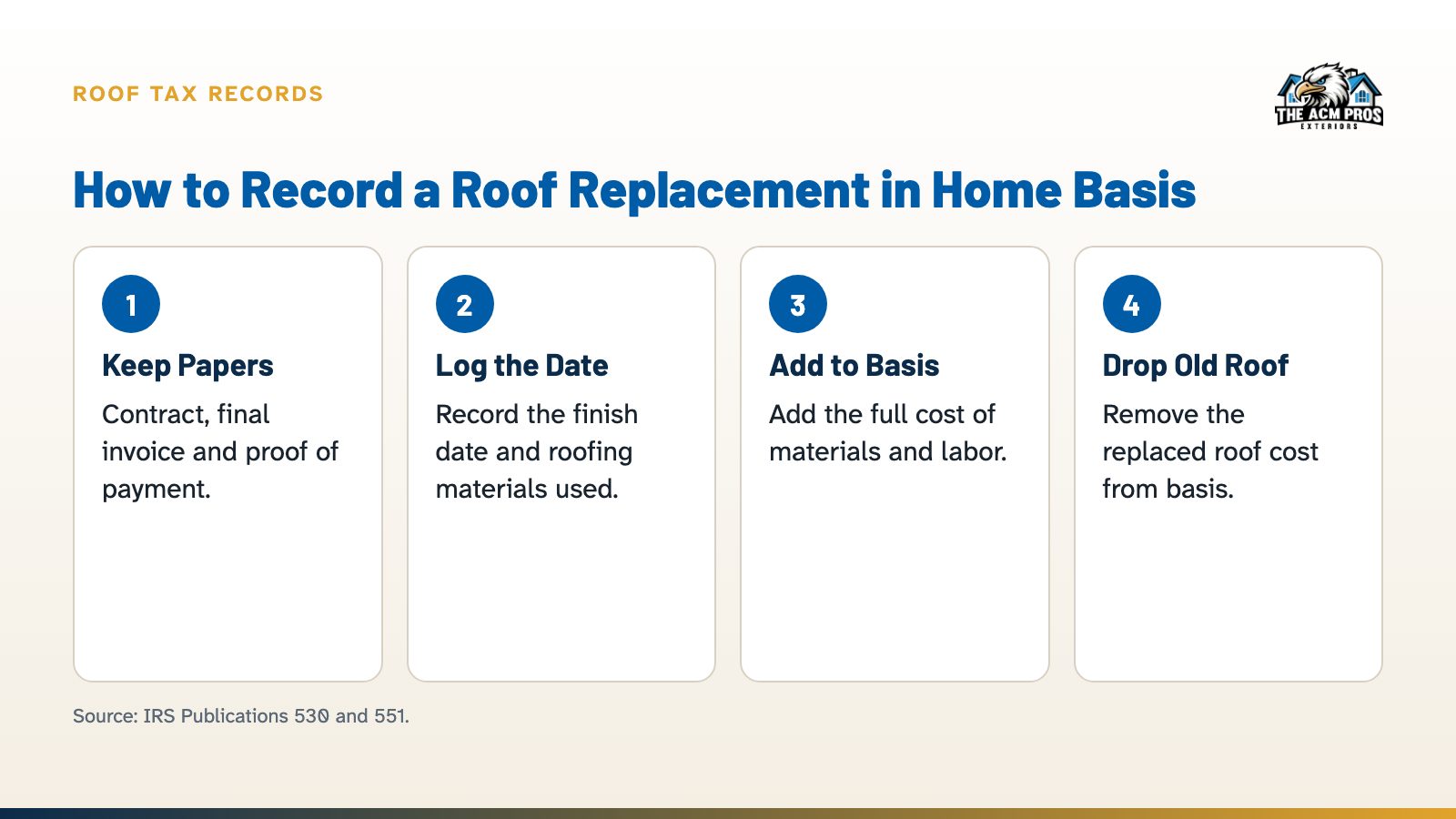
The infographic above shows the same record-keeping flow condensed into four panels. Home use is only one of four tax situations, and each one changes the answer.
Can I Deduct Roof Replacement on My Taxes for a Home Office?
You can deduct roof replacement for a home office only when you are self-employed and use the space exclusively. The share equals your business percentage, such as 15% when the office takes up 15% of the floor area. The deduction is not a single-year write-off.
The regular method treats that share of the roof as part of the home and depreciates it. Publication 587 states that the simplified method of $5 per square foot, up to 300 square feet, allows no depreciation. A roof cost therefore adds nothing under the simplified method.
Employees who work from home do not qualify for the home office deduction. Business owners should confirm the office percentage with a tax professional before filing. The next case, a rental property, follows a clearer set of rules.
Can You Deduct Roof Replacement on Taxes for a Rental Property?
You can deduct roof replacement on a rental property only over time, because a full replacement is depreciated rather than expensed. Publication 527 sets the recovery period for residential rental property at 27.5 years using the straight-line method. A new roof uses the same recovery period as the building it protects.
A CPA firm's worked example shows an $18,000 rental roof depreciating about $655 in a full year. Depreciation starts when the new roof is placed in service. Selling the property later can trigger depreciation recapture, so landlords keep the records. The chart below shows the yearly amount for four roof costs.
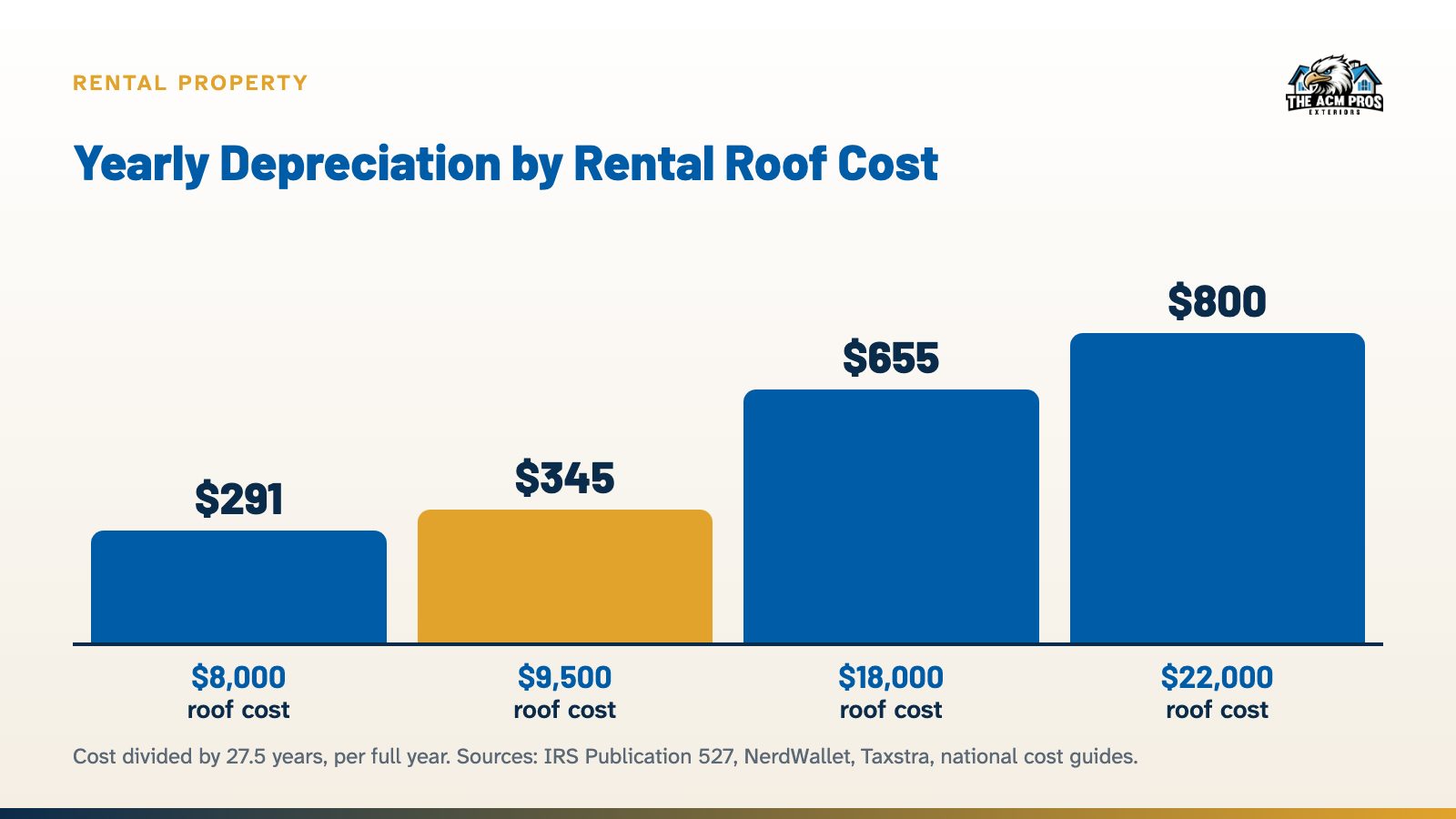
A small repair is different. Publication 946 states that repairing a small section of a rental roof is a rental expense. A complete replacement is an improvement you depreciate. Roofs on commercial buildings follow a 39-year schedule unless the Section 179 rule for roofs added to nonresidential property applies.
A short comparison table shows how the four main situations differ. Each row names the timing of the tax benefit.
Roof Replacement Tax Treatment by Situation
| Situation | Deduct in Year One? | How the Cost Is Used | IRS Source |
|---|---|---|---|
| Primary residence | No | Added to basis, lowers gain at sale | Pub 530, 551 |
| Home office | No | Business share depreciated (regular method) | Pub 587 |
| Residential rental | No | Depreciated over 27.5 years | Pub 527, 946 |
| Declared disaster loss | Possibly | Casualty loss after $100 and 10% of AGI limits | Pub 547 |
The table shows one pattern across the rows: no situation allows a plain year-one write-off. Disaster damage is the closest case, and it has its own limits.
Can a Roof Replacement Be Written Off on Taxes After Storm Damage?
A roof replacement can be written off on taxes after storm damage only as a casualty loss from a declared disaster. Through 2025, personal casualty losses qualified only when a federally declared disaster caused them. Beginning in 2026, the deduction also covers losses from state-declared disasters.
The loss is the lower of the roof's drop in value or its adjusted basis, minus any insurance payment. Each casualty is reduced by $100. The total is then reduced by 10% of adjusted gross income (AGI). Publication 547 explains the worksheet on Form 4684. The graphic below lays out the order of those subtractions.
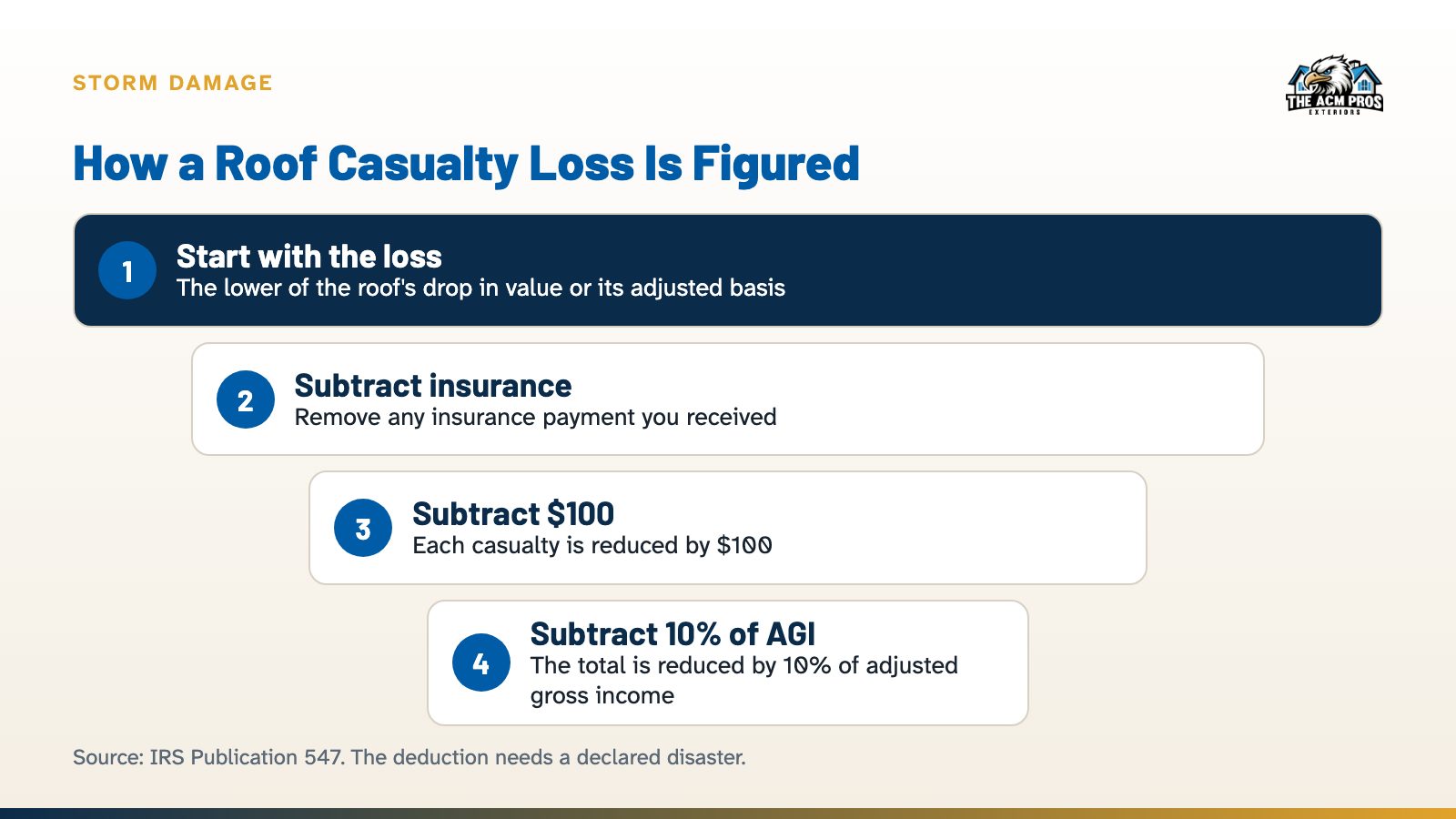
Insurance money also changes basis. Publication 530 states that insurance reimbursement for casualty losses decreases basis, while amounts you spend to restore damaged property increase it. Ordinary wear on an aging roof does not count as a casualty. The next question covers credits, which work differently from deductions.
Is There a Tax Credit for Roof Replacement in 2026?
No, there is no federal tax credit for roof replacement in 2026, because both home energy credits ended after 2025. The One Big Beautiful Bill Act ended the 25C Energy Efficient Home Improvement Credit. It also ended the 25D Residential Clean Energy Credit for property placed in service after December 31, 2025.
The 25D credit paid 30% of solar costs, including solar roofing tiles and shingles. Standard asphalt, metal or tile roofs never qualified under 25D. A homeowner who finished a qualifying project in 2025 can still claim the credit on that year's return with Form 5695.
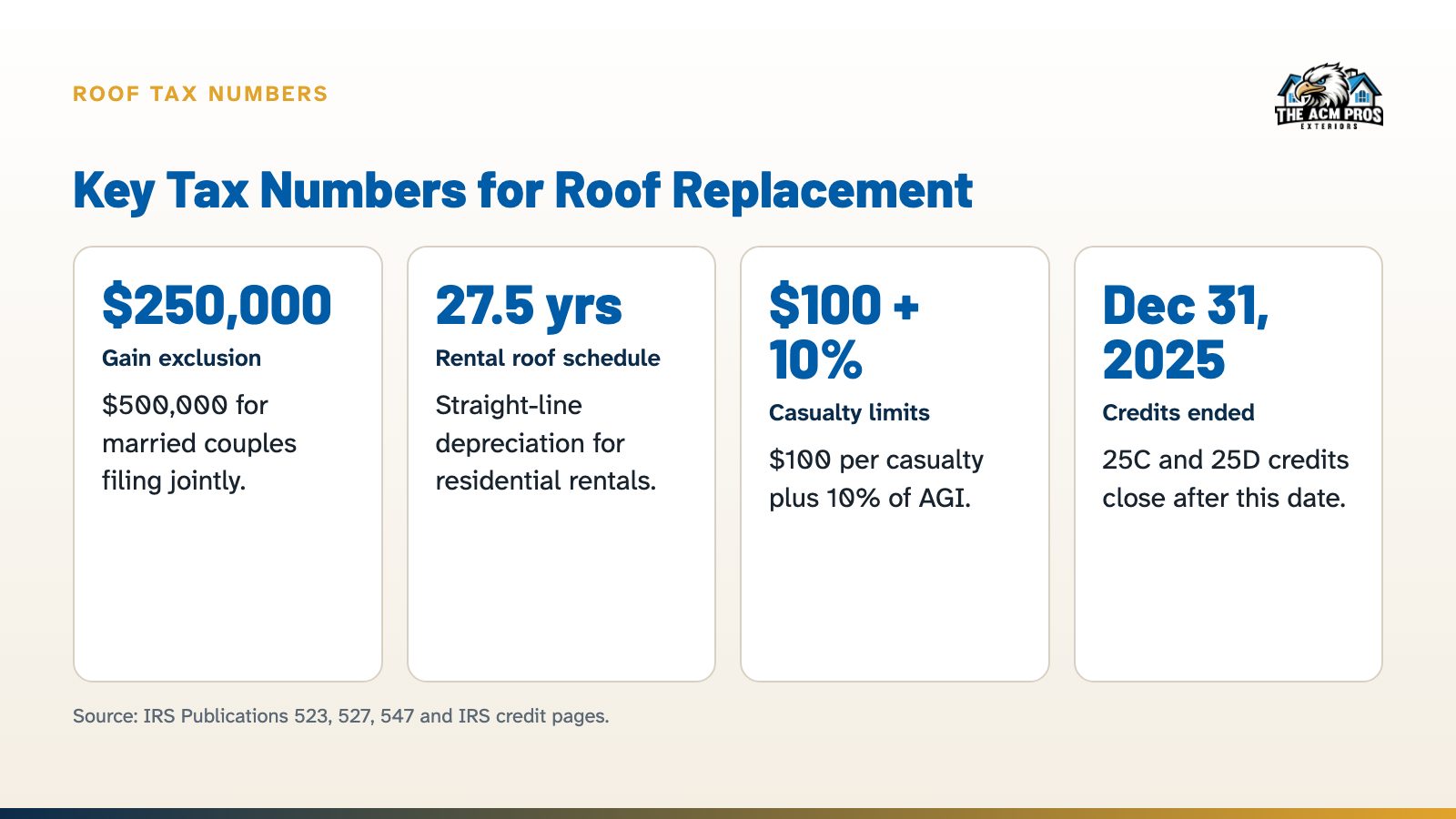
The infographic above gathers the main figures in one place. Several side questions come up before a roof project, and the next section covers them.
Which Roof Tax Rule Applies to Your Home?
The roof tax rule for your home depends on four facts: rental use, disaster damage, a home office and second-home use. The flow below sorts each case in four yes or no questions. A main home that answers no to all four gets no deduction and a higher basis.
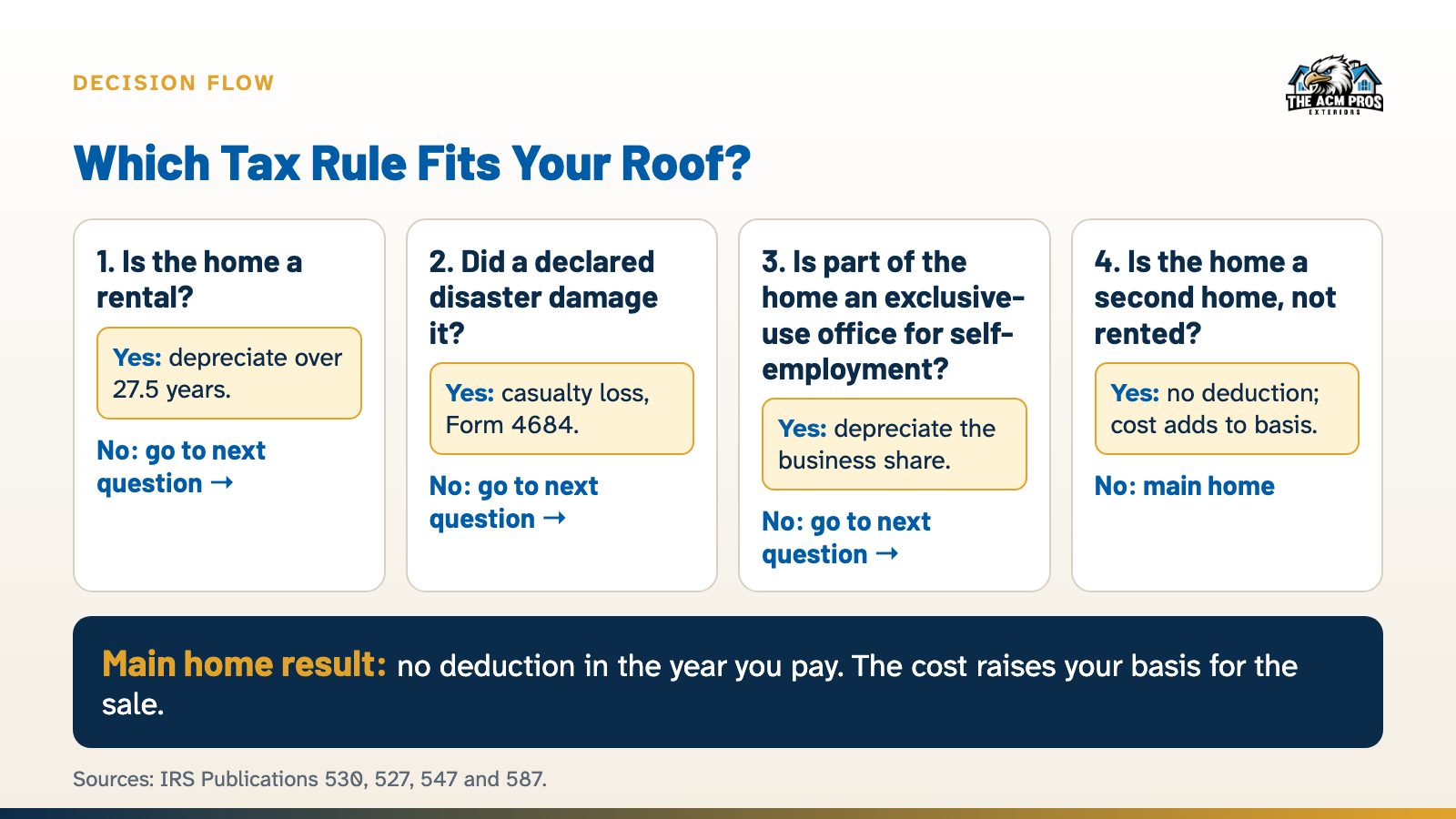
The flow follows the same IRS publications cited above. Dollar examples make each branch easier to compare.
What Does a $9,500 Roof Return on a Tax Bill?
A $9,500 roof returns about $345 a year to a landlord and up to $1,425 to a seller at 15%. NerdWallet puts the average roof replacement at about $9,500, and the table applies the IRS rules to that cost. The seller figure applies only when the sale gain passes the $250,000 exclusion.
Worked Tax Examples for a $9,500 Roof
| Situation | Math | Result |
|---|---|---|
| Rental property | $9,500 / 27.5 years | $345 per full year |
| Home sale above the exclusion | $9,500 added to basis x 15% | $1,425 less tax |
| Declared disaster, no insurance, $80,000 AGI | $9,500 - $100 - $8,000 | $1,400 deduction |
The 15% rate applies to taxable income from $48,350 to $533,400 for single filers, according to IRS Topic 409. The disaster row also requires itemizing on Schedule A. Each result changes with insurance payments, filing status and income, so a tax professional should confirm the final amounts.
What Roof Tax Myths Are Wrong?
Five roof tax myths are wrong, and the IRS publications correct each one. The table pairs each myth with the rule. The sources are the same IRS publications used throughout this guide.
Roof Tax Myths and the IRS Rule
| Myth | Rule | Source |
|---|---|---|
| A new roof is a Schedule A deduction | Home improvements cannot be deducted | Pub 530 |
| Every storm loss is deductible | Declared disasters only, after $100 and 10% of AGI | Pub 547 |
| Rental roofs are deducted at once | Replacements are depreciated over 27.5 years | Pub 527, 946 |
| The 25C credit still pays in 2026 | 25C ended after December 31, 2025 | IRS energy credit page |
| Remote employees deduct a home office | Only the self-employed qualify | Pub 587 |
The IRS also sets a $2,500 per invoice de minimis safe harbor for small purchases by businesses without audited financial statements. A full roof replacement usually exceeds that amount, so landlords depreciate it. The numbers below collect every limit in one list.
What Are the Key Roof Tax Numbers to Know?
The key roof tax numbers are 27.5 years, $250,000, $100 and 10%, and each one sets a limit or a schedule. The list gives each figure with its IRS source. Keep it with your closing papers and roof invoice.
- $250,000 gain exclusion for single filers, and $500,000 for joint filers (IRS Publication 523).
- 2 of the last 5 years of ownership and use to qualify for that exclusion (Publication 523).
- 27.5 years of straight-line depreciation for residential rental property (Publication 527).
- 39 years of depreciation for commercial buildings, unless Section 179 applies (Taxstra CPA guide).
- $100 reduction per casualty, then a 10% of AGI reduction on the total (Publication 547).
- $5 per square foot, up to 300 square feet, for the simplified home office method (Publication 587).
- $750,000 total mortgage debt limit for loans after December 15, 2017 (Publication 936).
- $2,500 per invoice de minimis safe harbor for small business purchases (IRS tangible property regulations).
- December 31, 2025 end date for the 25C and 25D credits (IRS credit pages).
These nine figures cover almost every roof tax question homeowners ask. Several side questions remain, and the next section answers them.
What Else Should You Know About Roof Replacement and Taxes?
Are Roof Repairs Tax Deductible?
Roof repairs are tax deductible only on rental or business property, not on a personal home. Publication 523 lists repairing roofs among repairs that keep a home in good order, and personal repairs are not deductible. We quote a repair when a repair is enough, and the tax result follows the same line. A full tear-off replacement is quoted when the deck and shingles are past repair.
Is a Roof Replacement a Capital Improvement?
A roof replacement is a capital improvement because it adds value and prolongs the life of the home. Publication 523 gives a new roof as an example of improvements that increase basis. A patch or leak fix stays a repair, which matters when only part of the roof needs work.
Is Roof Replacement Tax Deductible in 2026?
Roof replacement is not tax deductible in 2026 on a personal home, and the rule matches earlier years. The credits for energy upgrades ended after 2025. The casualty loss deduction grew to include state-declared disasters, which changes the storm case only.
Is Roof Replacement Tax Deductible for a Second Home?
Roof replacement is not tax deductible for an unrented second home, and the cost adds to its basis. A second home follows the same improvement rule as a main home. Renting it out part of the year changes the treatment, so a tax professional should review that case.
Can You Deduct Interest on a Loan for a New Roof?
You can deduct interest on a loan for a new roof only when your home secures the loan and you itemize. Publication 936 states that home equity loan interest qualifies when the money substantially improves the home that secures the loan. A $750,000 total mortgage limit applies to loans taken out after December 15, 2017.
Can I Claim a Roof Replacement on My Taxes If I Work From Home?
You can claim a roof replacement on your home office only as a depreciated business share when you are self-employed. Employees working from home cannot claim it. The regular method is required because the simplified method excludes depreciation.
Can You Claim Roof Replacement on Taxes When You Sell the House?
You can claim roof replacement on taxes at sale only through basis, which lowers your taxable gain. The $250,000 or $500,000 exclusion often covers the full gain. Records of the roof cost matter most when the sale profit exceeds that limit.
Does Added Attic Ventilation Change the Tax Result?
Added attic ventilation joins the improvement cost when installed with the new roof. New attic ventilation then becomes part of your basis. A simple cleaning is maintenance and is not deductible on a personal home.
How The ACM Pros Helps With a Roof Replacement
We help with the roofing side of the decision, and your tax professional handles the filing side. Our free written estimate itemizes the work, which gives you a clear invoice for your basis records. Our crews in North Alabama handle full tear-off roofing services with deck repair, underlayment and flashing. We price a repair separately from a replacement, since tax records treat the two differently.
Homeowners who want proof of our craftsmanship can review photos of finished roofs, siding and doors in our project gallery. The gallery shows jobs that we completed for local families across the region, with clear photos of each result.
Regular upkeep can extend the time between replacements. We offer roof washing as one maintenance option, separately from replacement, for homeowners who want their roofs cleaned between projects. You can book it without a roof job.
Estimate requests can go through our contact form or by phone. A crew member confirms the visit time with you, walks the roof with you and writes up the scope in plain language.
We are a family-owned exterior contractor that has served homeowners since 2019. Our licensed, insured crews write every roofing estimate for free and in writing. Each estimate lists the scope, the materials and the timeline.
Our team answers questions about scope, materials and timing by phone. Call (256) 585-6817 to schedule your free roof estimate.