How to Get Insurance to Pay for Roof Replacement
The key to how to get insurance to pay for roof replacement is proof of sudden damage from wind or hail. A roofer's written estimate backs the claim. The claim moves through 8 steps, from photos to the final payment.
By the ACM Pros team, Madison, AlabamaPublished 12 minute read
The key to how to get insurance to pay for roof replacement is proof of sudden damage from wind or hail. A roofer's written estimate backs the claim. The claim moves through 8 steps, from photos to the final payment. Age, neglect, and wear are not covered. A flat deductible of $1,000 to $5,000, or 1% to 5% of dwelling coverage, reduces the payout first.
Key Takeaways
- Insurance pays for roof replacement when a sudden covered event, such as wind, hail, fire, or a fallen tree, caused the damage.
- Age, neglect, and normal wear are not covered, so exact dates and records matter.
- Alabama requires an insurer to acknowledge a claim within 15 days.
- A $15,000 loss with a $1,000 deductible pays $14,000 on replacement cost and $4,000 on actual cash value with $10,000 of depreciation.
- Photos, a written roofer estimate, and the adjuster's estimate are the main records in a claim.
- Itemized evidence is the way to challenge a low estimate.
How to Get Insurance to Pay for Roof Replacement After Storm Damage?
Get insurance to pay for roof replacement by proving a sudden covered event damaged the roof beyond repair. Wind, hail, fire, lightning, and falling trees are covered events under standard homeowners policies. Age, neglect, and wear are not. A written estimate for a complete roof replacement shows the insurer why a patch falls short. Coverage depends on the cause of the damage, so the next section defines what qualifies.
What Qualifies a Roof to Be Covered by Insurance?
A roof qualifies for insurance coverage when a sudden, accidental event damages it and the policy does not exclude that event. The table below sorts common causes of roof damage by coverage.
Common causes of roof damage and how a standard homeowners policy treats them
| Cause | Usually covered | What the adjuster checks |
|---|---|---|
| Hail | Yes | Impact marks on shingles, vents, and metal |
| Wind | Yes | Creased, lifted, or missing shingles |
| Falling tree | Yes | Impact point and damage to the roof deck |
| Fire or lightning | Yes | Burn marks and strike points |
| Age and wear | No | Curling, brittleness, and granule loss |
| Neglect | No | Moss, clogged valleys, and old leak stains |
Policy wording still controls the result. The National Association of Insurance Commissioners (NAIC) notes that some policies exclude wind or hail coverage, which is common in coastal areas. Some policies also use separate deductibles for roof damage from wind or hail. Reading the declarations page is the first move, and the process below shows where it fits.
What Is the Insurance Roof Replacement Process?
The insurance roof replacement process has 8 steps, from documenting the damage to collecting the final payment. USAA describes a similar 5-stage claim path: report, inspect, review the estimate, repair or replace, and finalize.
- Document the damage with dated photos and video, and note the date of the storm.
- Review the policy for the deductible, the payout basis, and any wind or hail terms.
- Protect the home from further damage with a temporary tarp, and keep every receipt.
- Get a written, itemized estimate and inspection photos from a roofer.
- File the claim promptly with the date of loss and the first damage details.
- Meet the adjuster on the roof, with the roofer present when possible.
- Compare the adjuster's estimate with the roofer's estimate and request a supplement for missing items.
- Schedule the work after approval, then submit proof so the insurer releases any withheld depreciation.
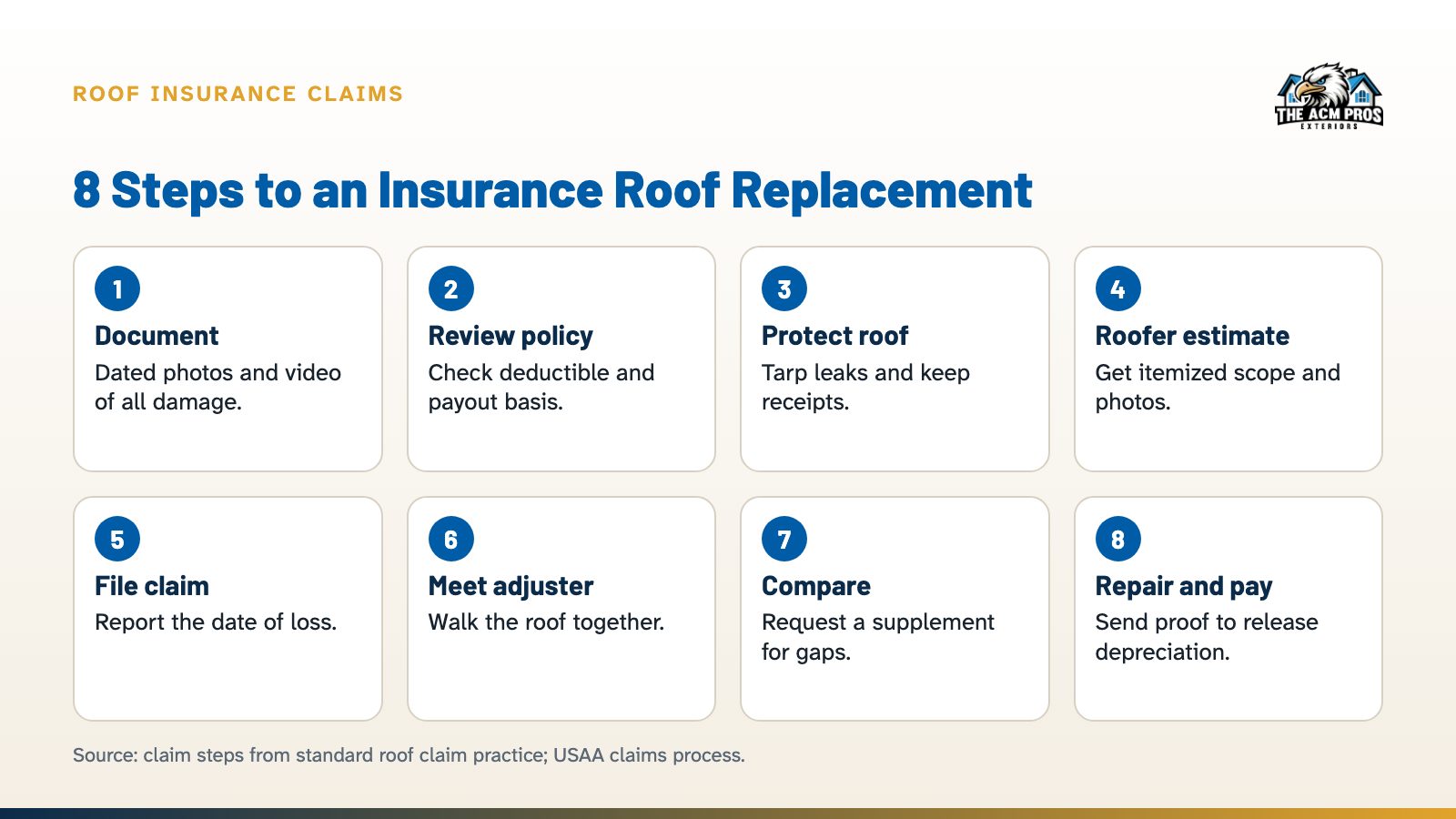
The graphic above shows the 8 steps in order. The roof replacement insurance process pauses at approval, and the tear-off work starts once the scope and payout are settled. Timing is the next question most homeowners ask.
How Long Does It Take for an Insurance Adjuster to Look at Your Roof?
An adjuster has no single set inspection date, but Alabama requires an insurer to acknowledge a first-party claim within 15 days. The same rule requires an acceptance or denial notice within 30 days, or the period the policy states, after proof of loss. A policy may set a different number of days.
The Alabama Department of Insurance publishes these standards in Administrative Code chapter 482-1-125. Storm volume can lengthen the wait for a visit. Filing early and sending photos keeps the claim moving toward the inspection itself.
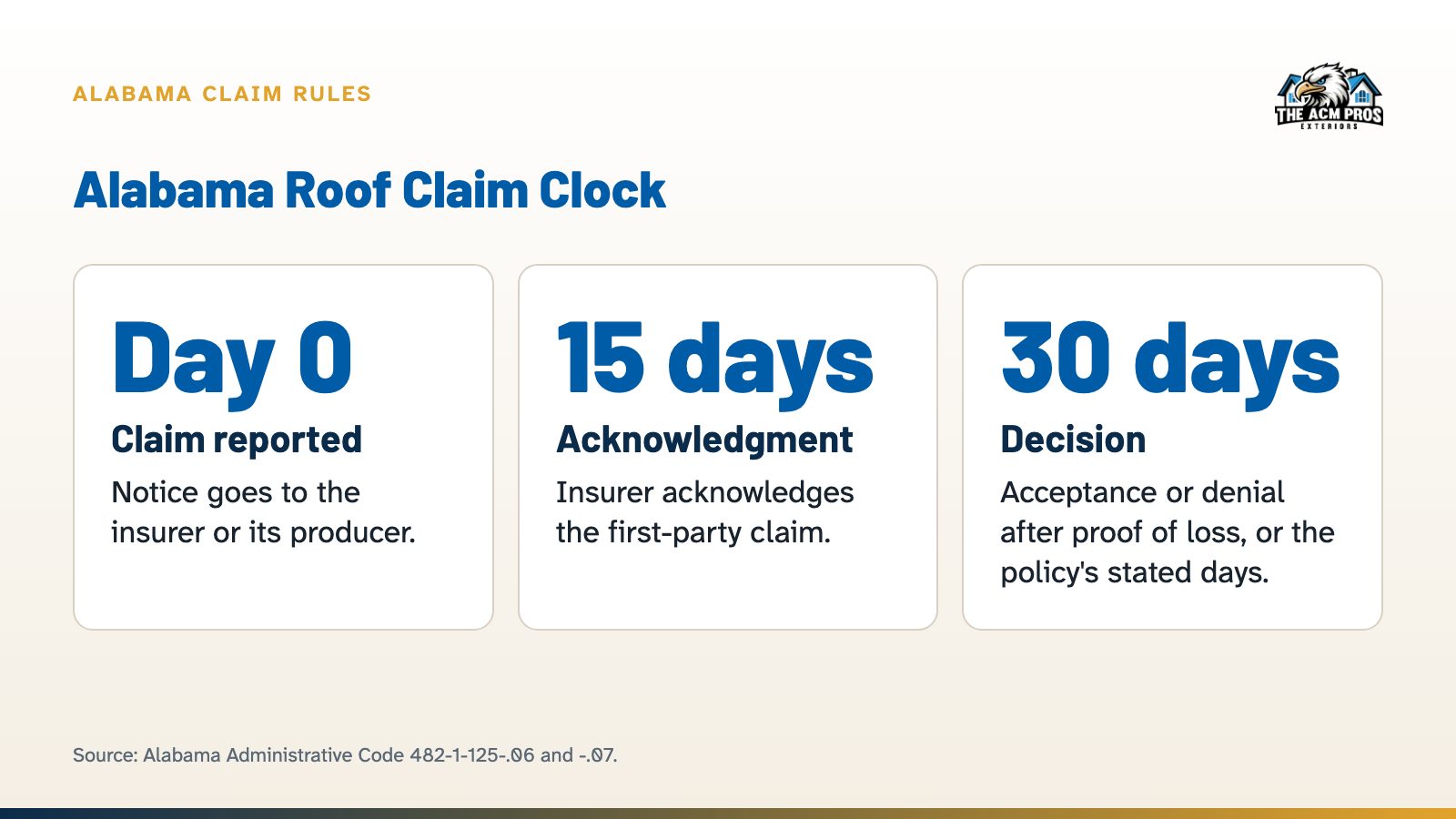
The graphic above marks the two Alabama deadlines. The inspection is where those deadlines meet the roof itself.
What Do Roof Adjusters Look For?
Roof adjusters look for the cause, the extent, and the age of the damage. Each finding decides whether the loss counts as sudden covered damage or as wear.
- Cause: hail bruises, wind creases, or an impact point from a fallen limb.
- Extent: the number of damaged slopes and the share of shingles affected.
- Condition: curling, granule loss, and the roof's age.
- Related damage: vents, flashing, and fascia and soffit near the impact.
- Interior signs: ceiling stains and wet insulation under the damaged area.
These findings feed the estimate, and the estimate sets the payout. The next section explains how that payout is calculated.
How Does Insurance Cover Roof Replacement?
Insurance covers roof replacement at either replacement cost value or actual cash value, minus the deductible. The NAIC states that replacement cost pays to repair or replace damaged property without deducting depreciation. Actual cash value pays the depreciated cost instead. The table shows the NAIC example of a $15,000 roof loss with a $1,000 deductible.
Payout on a $15,000 roof loss with a $1,000 deductible
| Payout basis | Depreciation deducted | Insurer pays |
|---|---|---|
| Replacement cost value | None | $14,000 |
| Actual cash value | $10,000 | $4,000 |
The gap between the two payouts is $10,000 in this example. Roof age and condition set the depreciation amount, so an older roof loses more value on paper.
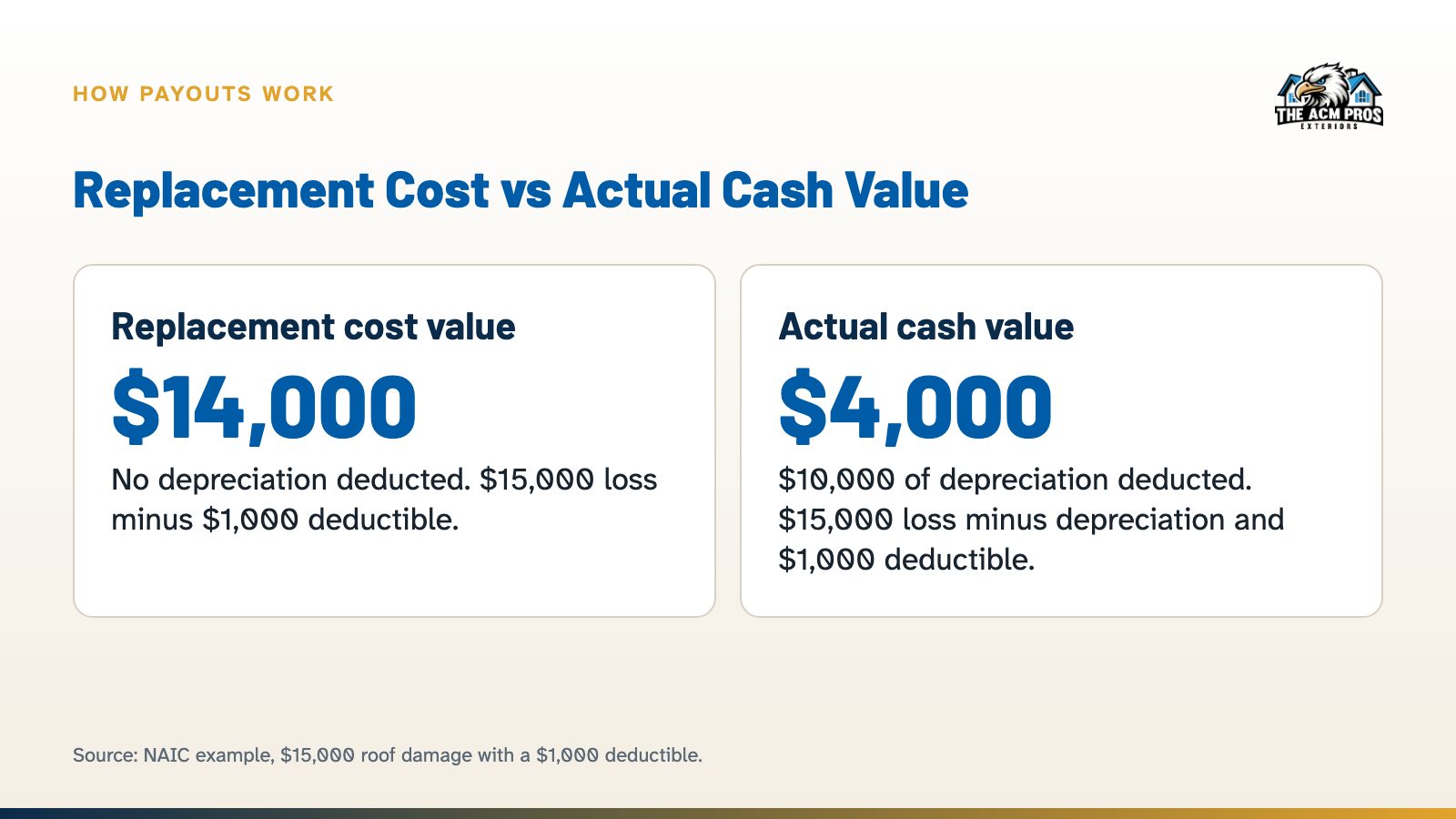
The graphic above restates the table in two panels. The deductible is the other number that shapes the check.
What Is the Insurance Deductible for Roof Replacement?
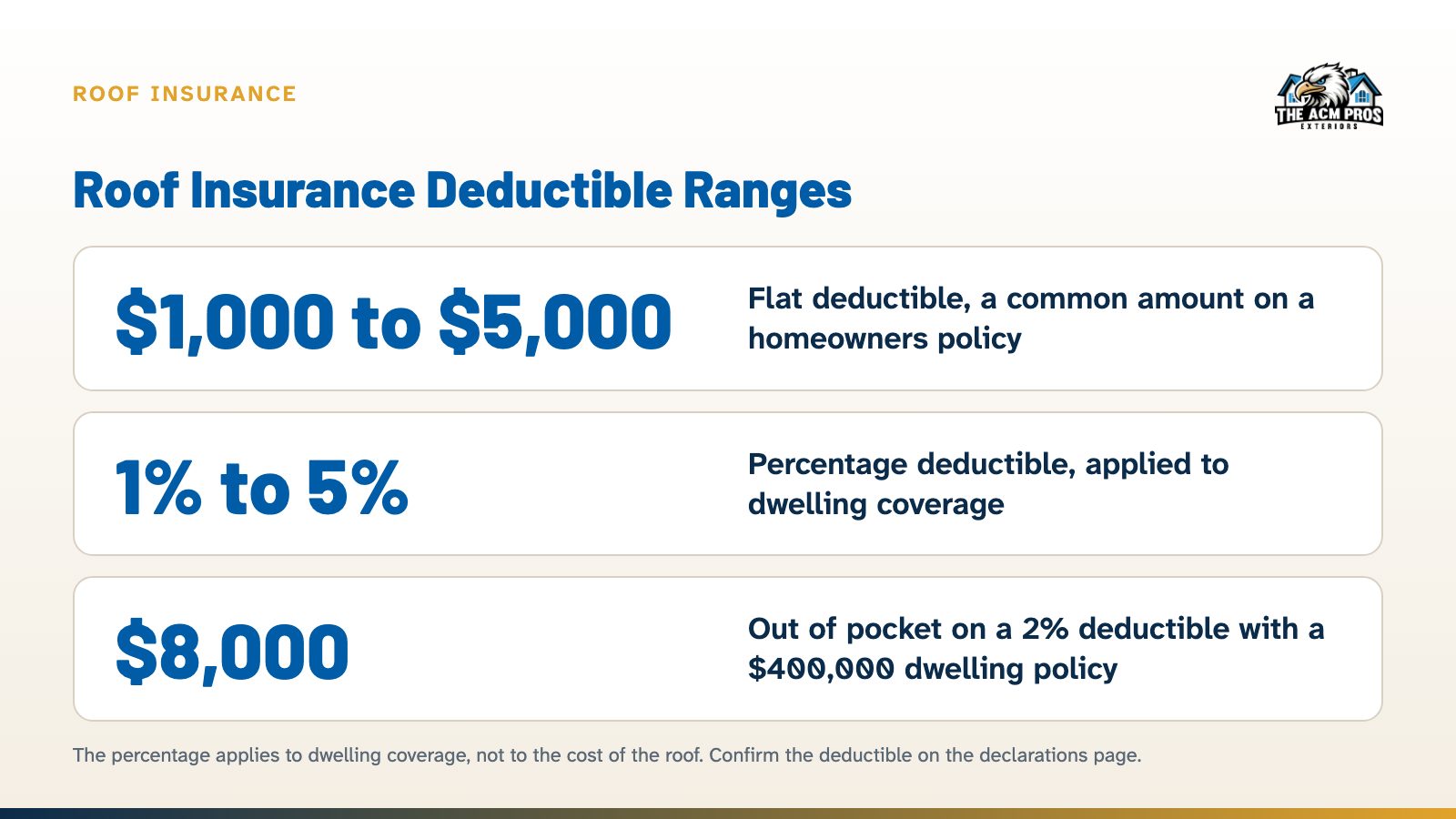
The insurance deductible for roof replacement is a flat amount, often $1,000 to $5,000, or 1% to 5% of dwelling coverage. A 2% deductible on a $400,000 dwelling policy equals $8,000 out of pocket.
The percentage applies to dwelling coverage, not to the cost of the roof. Some policies carry a separate wind or hail rate. The roof replacement insurance deductible appears on the declarations page, so confirm it before filing. A low estimate near the deductible leaves little to collect, which makes the filing decision worth a calculation. The graphic below shows the three deductible figures.
How Does the Insurance Check for Roof Replacement Work?
An insurance check for roof replacement arrives as one payment or two, depending on the payout basis. A policy may pay actual cash value first and release the withheld depreciation after proof that the work is complete.
A mortgage lender may be named as a payee on the check. Confirm the payee names with the insurer before the contractor starts, because a lender endorsement can add days. Payment is only part of the claim, and the adjuster's estimate is the other part.
How to Negotiate Roof Replacement with Insurance?
Negotiate roof replacement with insurance by sending itemized evidence for every item the adjuster's estimate left out. Homeowners can push back when an initial estimate misses damage. Four kinds of evidence carry the most weight in a response.
- A roofer's written, itemized estimate that matches each line of the adjuster's scope.
- Dated photos of every damaged slope and the related damage.
- Code-required items, such as drip edge or roof ventilation, that the local building code requires.
- Maintenance records that show the roof was in sound condition before the storm.
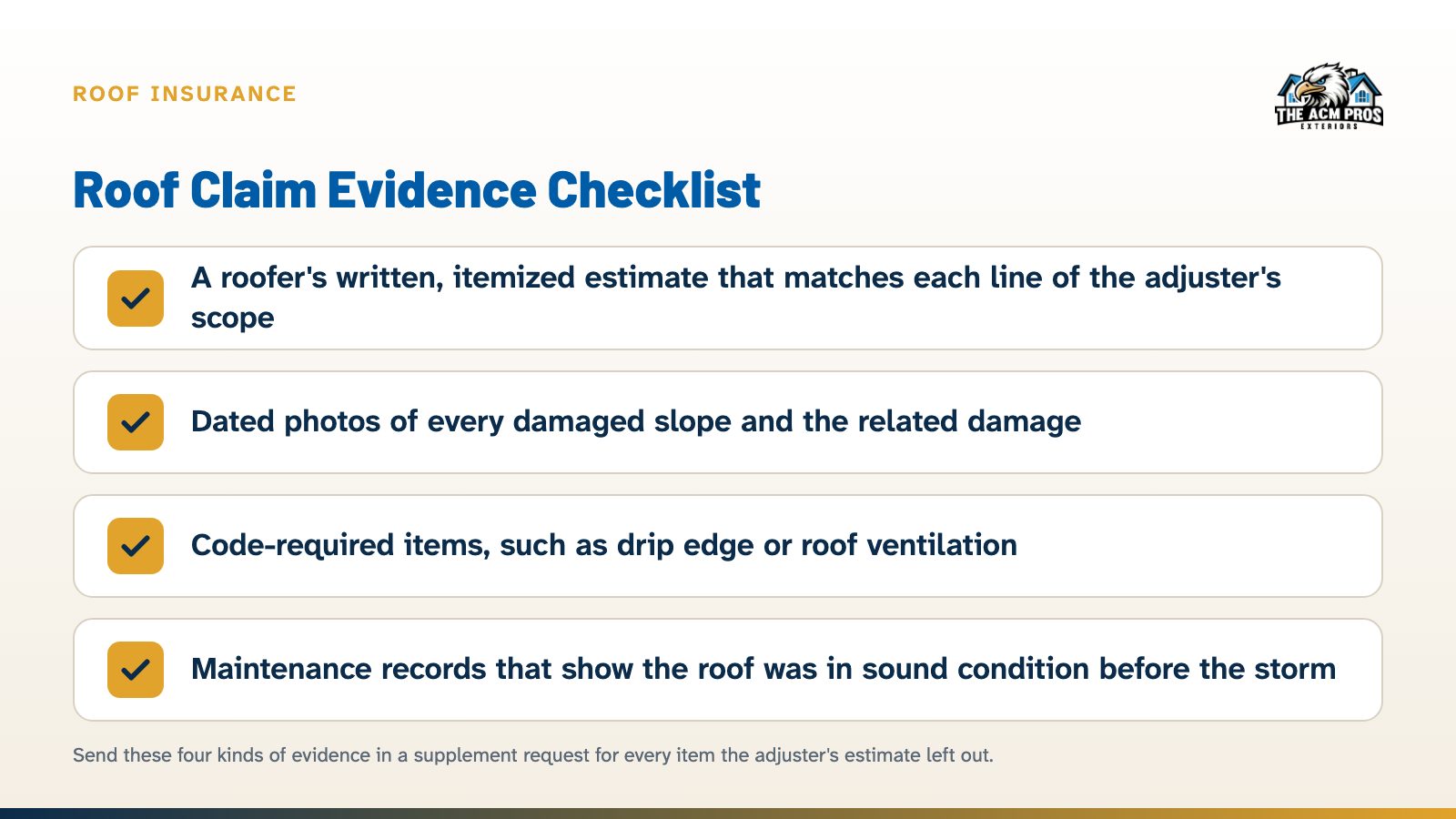
The checklist above covers the four kinds of evidence. A supplement request puts these items in writing, and the insurer reviews them against the policy. Policies may include an appraisal clause that lets each side name an appraiser when the amounts differ. The words used with the adjuster also shape the file, as the next question shows.
What Not to Say to a Roof Insurance Adjuster?
Avoid guessing, admitting fault, or blaming age when talking with a roof insurance adjuster. The adjuster records every statement in the claim file.
- Skip phrases like "the roof was old anyway." Give the install date from records instead.
- Skip phrases like "it has been leaking for months." State only what was seen and when.
- Skip guesses about the cause or the date. Name the storm and the day the damage was found.
- Skip any agreement to a final payout on the spot. Ask for the estimate in writing.
- Skip downplaying the damage. Point out every area the roofer marked.
Calm, factual statements keep the claim on solid ground. A denial can still arrive, and the next question covers it.
What If the Insurance Company Denies the Roof Claim?
A denied roof claim can be answered with a written request for the policy provision behind the denial. Alabama's claims rule requires a denial that relies on a policy exclusion to reference that provision.
A second roofer inspection with photos can address the stated reason, such as wear versus storm damage. A state insurance department can review complaints about claim handling. Denials turn on cause and payout math, so a worked example shows how the numbers play out.
What Does a Roof Insurance Payout Look Like on a Real Claim?
A roof insurance payout equals the covered repair cost minus depreciation and minus the deductible. The table applies that formula to the NAIC $15,000 roof loss. It compares a $1,000 flat deductible with $8,000, which is 2% of a $400,000 dwelling limit.
Illustrative payout on a $15,000 roof loss by policy type and deductible
| Policy basis | Deductible | Depreciation | Insurer pays |
|---|---|---|---|
| Replacement cost value | $1,000 | None | $14,000 |
| Replacement cost value | $8,000 | None | $7,000 |
| Actual cash value | $1,000 | $10,000 | $4,000 |
| Actual cash value | $8,000 | $10,000 | $0 |
The table is an illustration built from the NAIC loss example and the 2% deductible example, not a quote for any home. On the last row, depreciation and deductible together total $18,000, which exceeds the $15,000 loss. The spread between the highest and lowest payout is $14,000. Two policy lines on the declarations page decide which row applies, so read them before filing.
The same math tests a smaller job. A roof repair near the Fixr average of $400 to $2,000 can fall under a flat deductible of $1,000 and pay nothing. The key numbers below put every threshold in one list.
What Are the Key Numbers for an Insurance Roof Claim?
The key numbers for an insurance roof claim are 15 days, 30 days, 45 days, $1,000 to $5,000, and 1% to 5%. The list below gives each figure with its source.
- 15 days: the time an Alabama insurer has to acknowledge a first-party claim and provide claim forms (Alabama Administrative Code 482-1-125-.06).
- 30 days: the time to advise acceptance or denial after proof of loss, or the days the policy states (rule 482-1-125-.07).
- 45 days: the interval for written status updates while an investigation stays open (rule 482-1-125-.07).
- 10 working days: the time an insurer has to answer an Insurance Department inquiry about a claim (rule 482-1-125-.06).
- $1,000 to $5,000: the flat deductible range commonly quoted in insurance guides for roof replacement.
- 1% to 5%: the percentage deductible range on dwelling coverage, with wind and hail rates reaching 10% on some policies (Policygenius).
- $14,000 versus $4,000: the replacement cost and actual cash value payouts on a $15,000 loss with a $1,000 deductible (NAIC).
- $8,000 to $22,000: the replacement cost of a 2,000-square-foot roof with standard materials (national roofing cost guides).
- $400 to $2,000: the average roof repair cost (Fixr).
- 46.4%: the share of homeowners insurance losses from wind and hail in 2024 (Triple-I).
The first four figures are Alabama rules, so another state sets its own days and the state insurance department publishes them. Several shorter questions sit beside these numbers, starting with whether a claim is worth filing.
What Else Should You Know About Insurance and Roof Replacement?
Is It Worth Going Through Insurance for a New Roof?
Going through insurance is worth it when covered damage costs more than the deductible by a wide margin. Fixr puts the average roof repair at $400 to $2,000, which can sit below a deductible. A full replacement estimate is a different calculation.
Does a Roof Claim Make Insurance Go Up?
A roof claim can raise homeowners insurance rates, though the increase does not happen automatically. Rate changes depend on the insurer, the claim, and the policy history.
Will Insurance Cover a 20 Year Old Roof?
Yes, insurance can cover a 20-year-old roof for sudden covered damage, but not for age or wear. Replacement cost policies pay without age deductions. Actual cash value policies reduce the payout for depreciation. Roofs of 12 or 30 years follow the same covered-peril rule, with tighter terms on older roofs.
Will Insurance Pay for a Roof That Is Simply Old?
No, insurance will not pay for a roof that is simply old, because standard policies exclude age and wear. Wear is a maintenance cost, not a sudden loss.
Can an Insurance Company Tell You to Get a New Roof?
An insurance company can condition roof coverage on the roof's condition, such as moving an aging roof to actual cash value. Carriers may change roof terms at renewal, so read each renewal notice.
How Do You Know If Your Roofing Contractor Is Ripping You Off?
Warning signs of a bad roofing contractor include high-pressure tactics, vague or unusually low bids, large upfront payment demands, and missing credentials. Offers to waive the deductible are another red flag. Ask for an Alabama license, proof of insurance, and a written itemized estimate. Reading contractor reviews adds a final check.
How to Pay for a Roof When You Can't Afford It?
A homeowner can pay for a roof through a covered claim, repair programs, loans, or lender financing. Targeted repairs can also buy time until a replacement fits the budget.
How Much Should a 2000 Sq Ft Roof Cost to Replace?
A 2,000-square-foot roof replacement costs $8,000 to $22,000 for standard materials. Material, roof pitch, and the number of tear-off layers move the price within that range.
Is Replacing Your Roof Tax Deductible?
Replacing the roof on a primary residence is generally not tax deductible in the year of payment. No federal tax credit applies to a standard roof replacement in 2026.
Frequently Asked Questions
How Does Roof Replacement Work With Insurance?
Roof replacement works with insurance by paying for covered damage after an adjuster approves the scope. The homeowner pays the deductible, and the insurer pays the rest according to the policy.
How Do I Make a Successful Roof Leak Insurance Claim?
Make a successful roof leak claim by proving a sudden covered event, such as a storm, caused the leak. Photograph interior stains, tarp the opening, and keep receipts.
Does Homeowners Insurance Cover Roof Leaks From Rain?
Homeowners insurance covers a rain leak when a covered event, such as storm damage, opened the path for water. Leaks from gradual wear stay excluded.
When Should You Schedule the Roof Work After a Claim?
Schedule the roof work once the insurer approves the scope, and note that late fall through winter brings lower contractor demand.
Can I Sell My House With a 20 Year Old Roof?
Yes, a house with a 20-year-old roof can be sold, and no rule requires replacing the roof before listing. A roofer's inspection report documents the roof's condition for buyers.
What Is the Biggest Mistake People Make With an Insurance Claim?
Waiting too long and filing without documentation are the main claim mistakes. Dated photos and prompt notice protect the claim.
How Can We Help With a Roof Replacement After an Insurance Claim?
We help homeowners replace the roof after a claim moves forward, starting with a written estimate that itemizes the work. Learning how to get insurance to pay for roof replacement ends with hiring a contractor. The claim itself stays between you and your insurer.
We are a family-owned contractor run by Brad and Chase Miller since 2019. Our Alabama license and insurance cover the roofing work itself, while the claim stays with your insurer. We explain every line of the estimate before work starts.
Our roofing work covers full tear-off replacement, deck repair, underlayment, flashing, and attic ventilation. We quote a repair when a repair is enough, and we say so in writing before any crew arrives.
Each new roof installation begins with an inspection of the deck and ends with a cleaned-up property. The insurer's scope guides the plan, and the written estimate documents any extra items found once the old shingles come off.
Homeowners can request a free written estimate before or after the adjuster visit. Our estimates itemize tear-off, decking, underlayment, flashing, and ventilation as separate lines. Bringing the adjuster's estimate to the appointment helps us compare each line item with the work the roof needs.
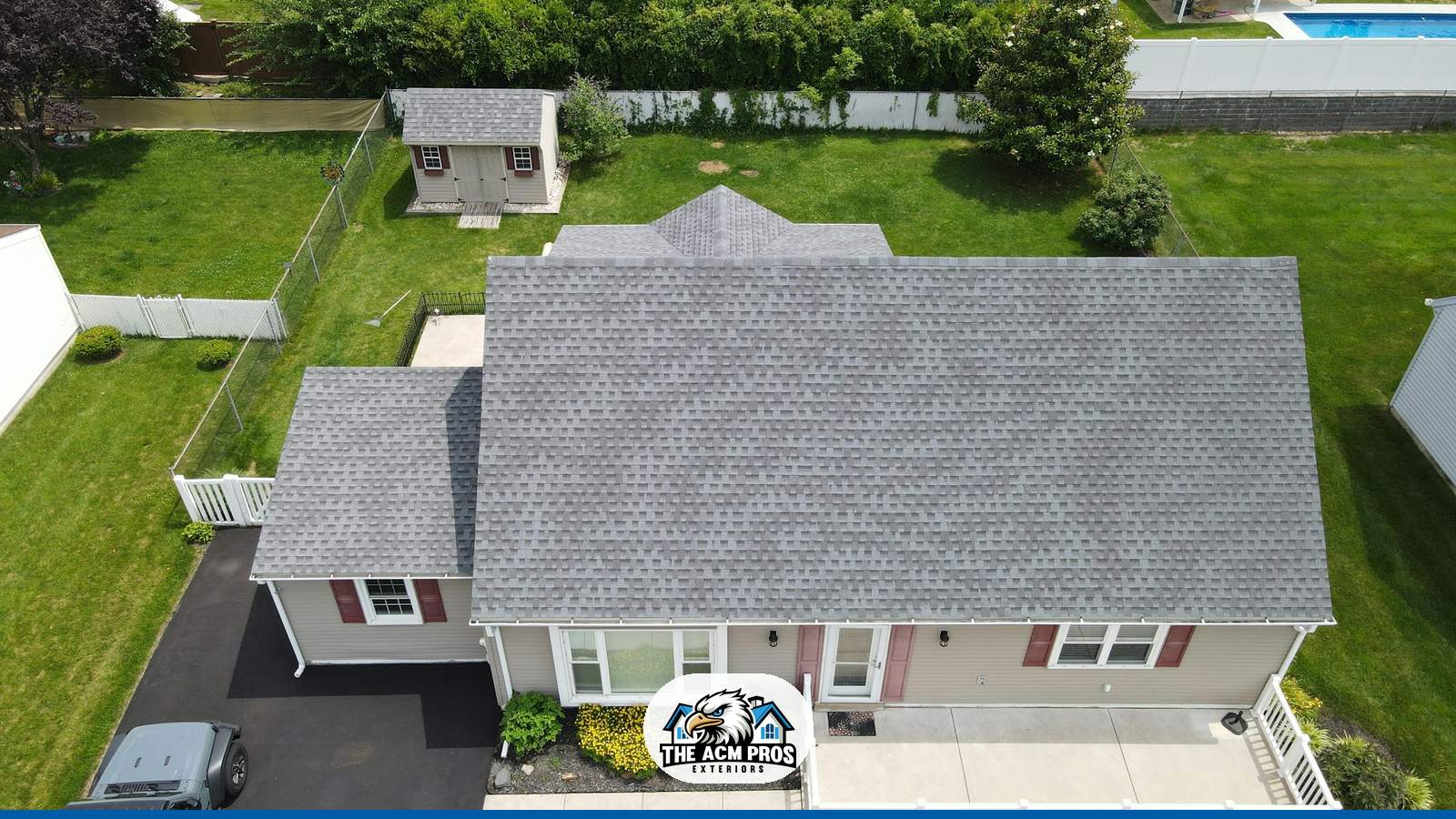
Our roofing job photos show the finished work on real homes. Reading the photos alongside the estimate shows what a finished roof looks like on a real house.
We serve homeowners across the service areas in North Alabama and Middle Tennessee. Brad and Chase Miller, a father and son team, run the business. Free written estimates cover the full scope of the roof replacement. Each estimate lists the materials, the tear-off, and the cleanup in plain terms.
Meeting the family behind ACM Pros takes one phone call. Brad and Chase Miller answer questions about the estimate, the schedule, and the steps of the work in plain terms. Written estimates are free, and the visit does not obligate you to hire us.
Call (256) 585-6817 to schedule a free written estimate.